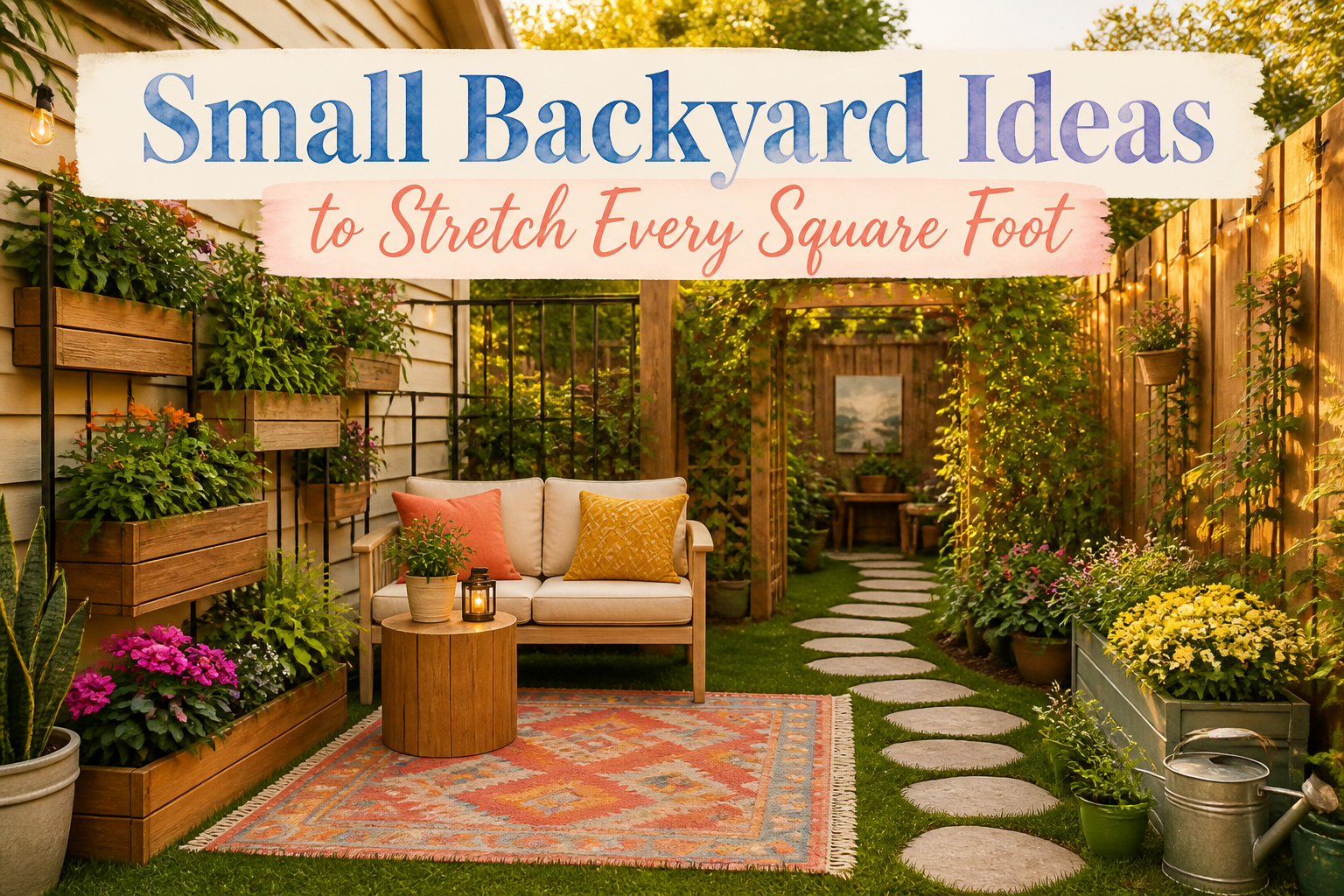
A small backyard idea only works if it matches how you actually move through the space, not how the space looks in a photo. The same 12-by-16 patch can feel like three usable rooms or one crowded corridor, and the difference is usually a hose laid on the ground for a week to test where feet actually go. My own refresh ran $890, and half the plant budget was impulse buys that looked smaller on the cart than they turned out in the ground.
1. Consider Your Priorities
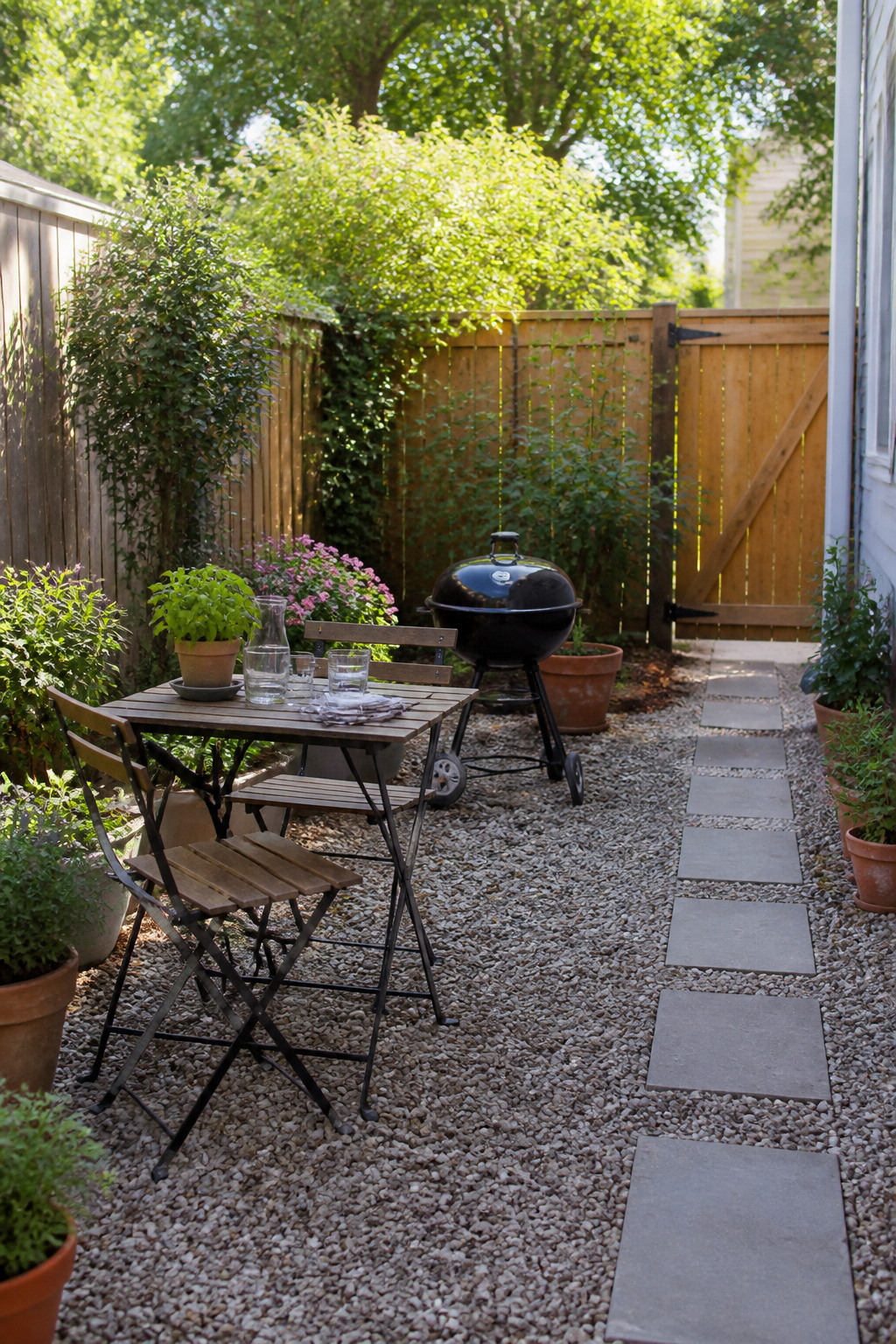
A small backyard fills up faster than you think. I learned this watching a neighbor squeeze in a grill, a toddler slide, and raised beds until the only path left was a single stepping-stone route to the fence. Every feature demanded its own footprint, and nothing had room to breathe.
Prioritize what you actually do out there, not what looks good in a catalog. Seating takes roughly the same ground as a play structure, and both eat the space a garden needs. Rank them before you buy anything. For my own yard, I wrote the list on a Saturday morning: eat outside, read outside, let the dog run. Storage and flowers came last. That order meant a folding table and a patch of gravel won over built-in benches I would have regretted by July.
The sources I read split on flexibility. One approach says commit hard to your top two needs and let the rest go. Another argues for movable furniture and clear edges so the same ground can shift from dining to lounging to catch. The second costs more in time, less in regret. I lean that way for anyone who uses their yard daily, because the meal you eat out there changes with the season, and the space should change with it.
2. Create a Functional Layout
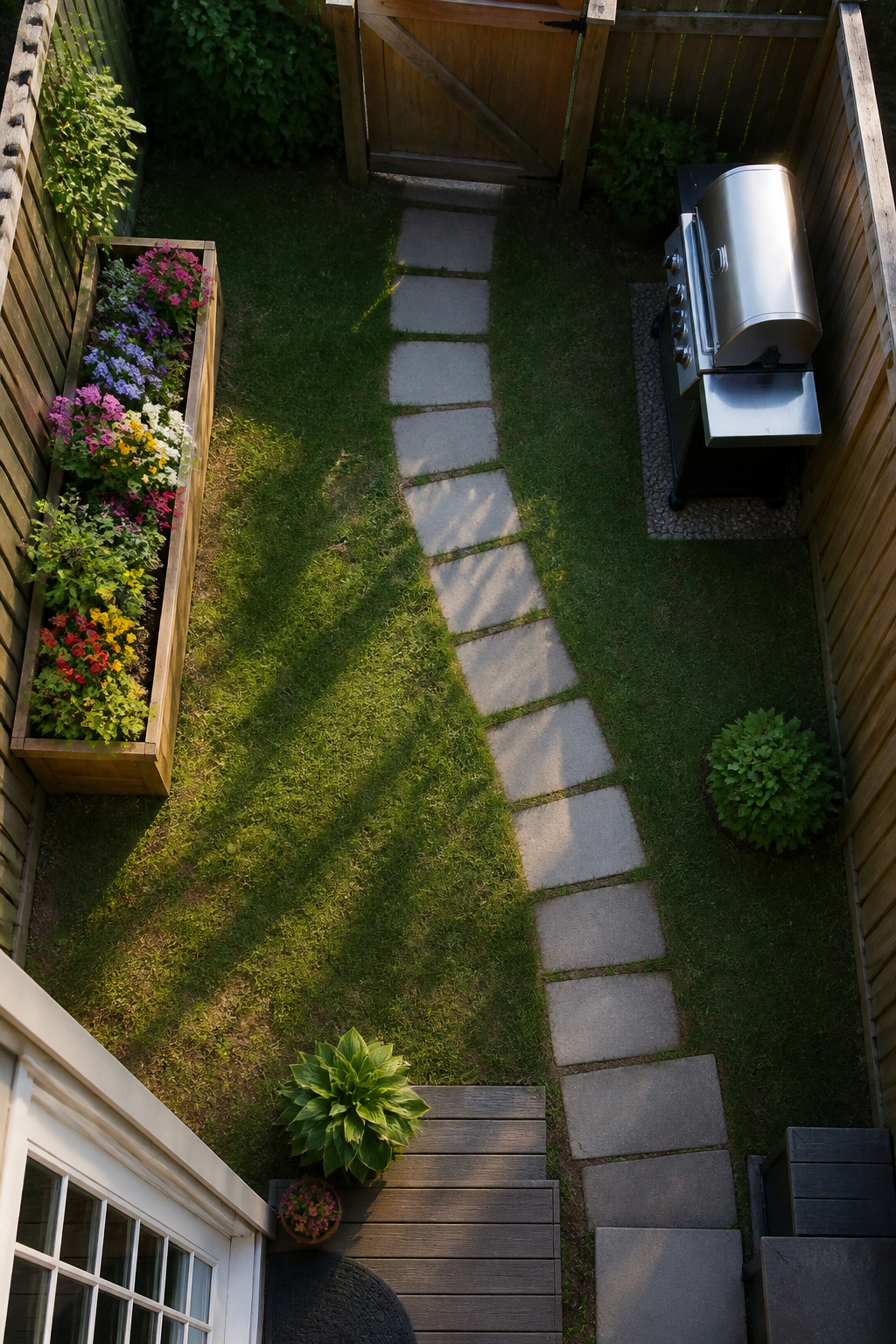
The first thing I laid out was the path from the back door to the alley gate, because once a planter box or a grill is sitting there, no one wants to move it twice. Keep 30–36 inches clear for any route you plan to walk with a tray of burgers or a hose reel. Anything narrower and you will find yourself doing a sideways shuffle every Saturday.
Before I spent money on pavers or raised beds, I traced the whole layout with a garden hose and left it for a week. When the hose kept getting kicked out of place, I knew that corner was too tight. Cardboard boxes flattened into "furniture" work the same way, and they cost nothing. A dead-end patio tucked behind a shed feels smaller than it is, because you have to backtrack. A loop, even a narrow one, lets the eye travel and the space read as larger than the fence lines say it should be.
3. Blend Indoor-Outdoor Living
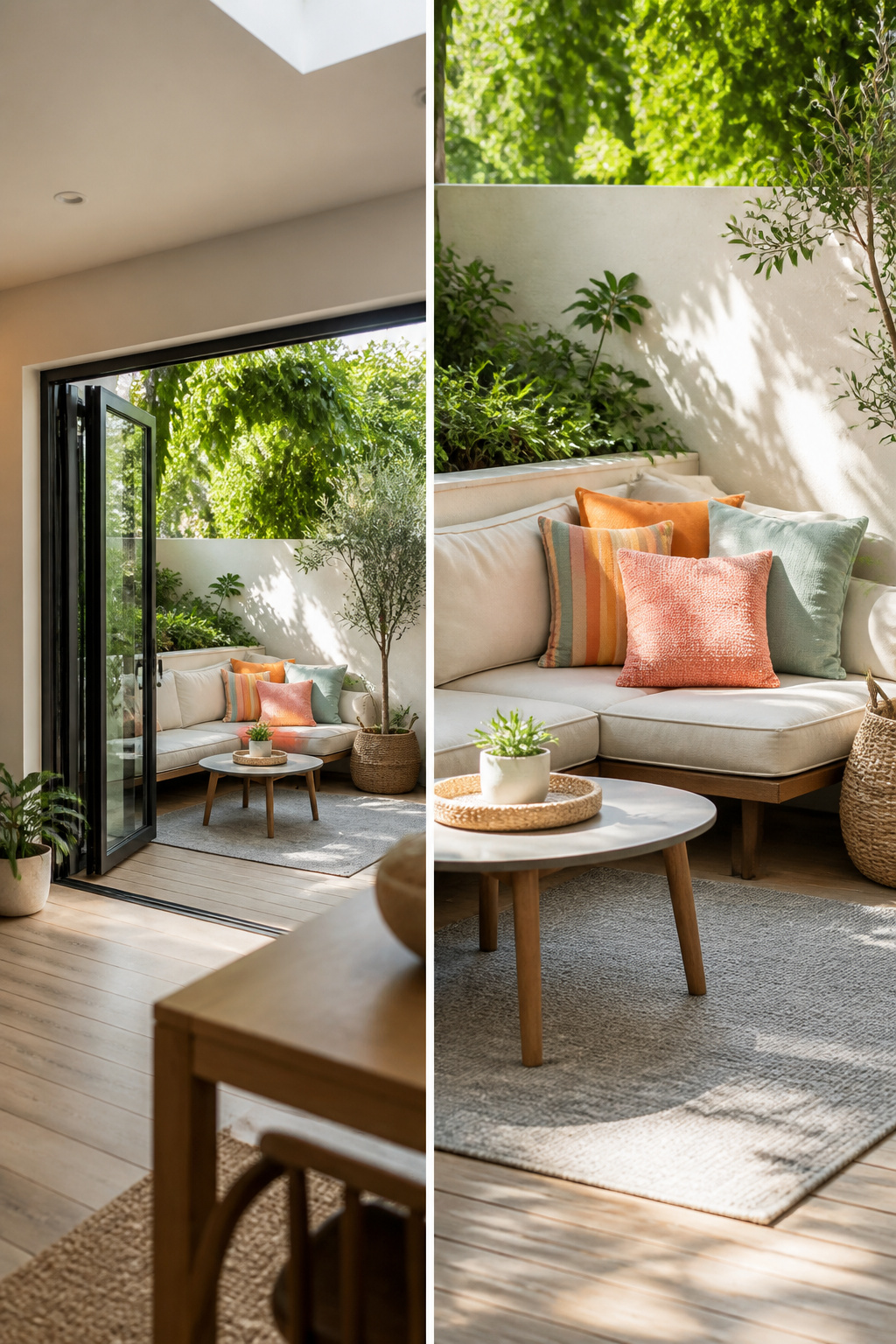
The fastest way to make a small backyard feel larger is to erase the line between inside and out. Matching the flooring from your kitchen or living room straight through to a patio tricks the eye into reading one continuous space. Paint helps too; carry the same wall color past the door frame and the wall seems to keep going.
French doors open wide and swing, which feels romantic but eats square footage a slider doesn’t. A basic 6-foot sliding door runs about what you’d spend on a mid-range appliance install, though quotes swing hard by region and whether you’re cutting a new opening or replacing an existing frame.
For years I treated "indoor-outdoor" as permission to drag any rug outside. The striped cotton ones looked sharp for about two weeks, then the underside turned to green velvet. Mold, not décor. Now I stick to polypropylene or just leave the floor bare. The sight line matters more than the softness underfoot, and a clean visual path beats a soggy one every time.
4. Use Visual Tricks to Enhance Space
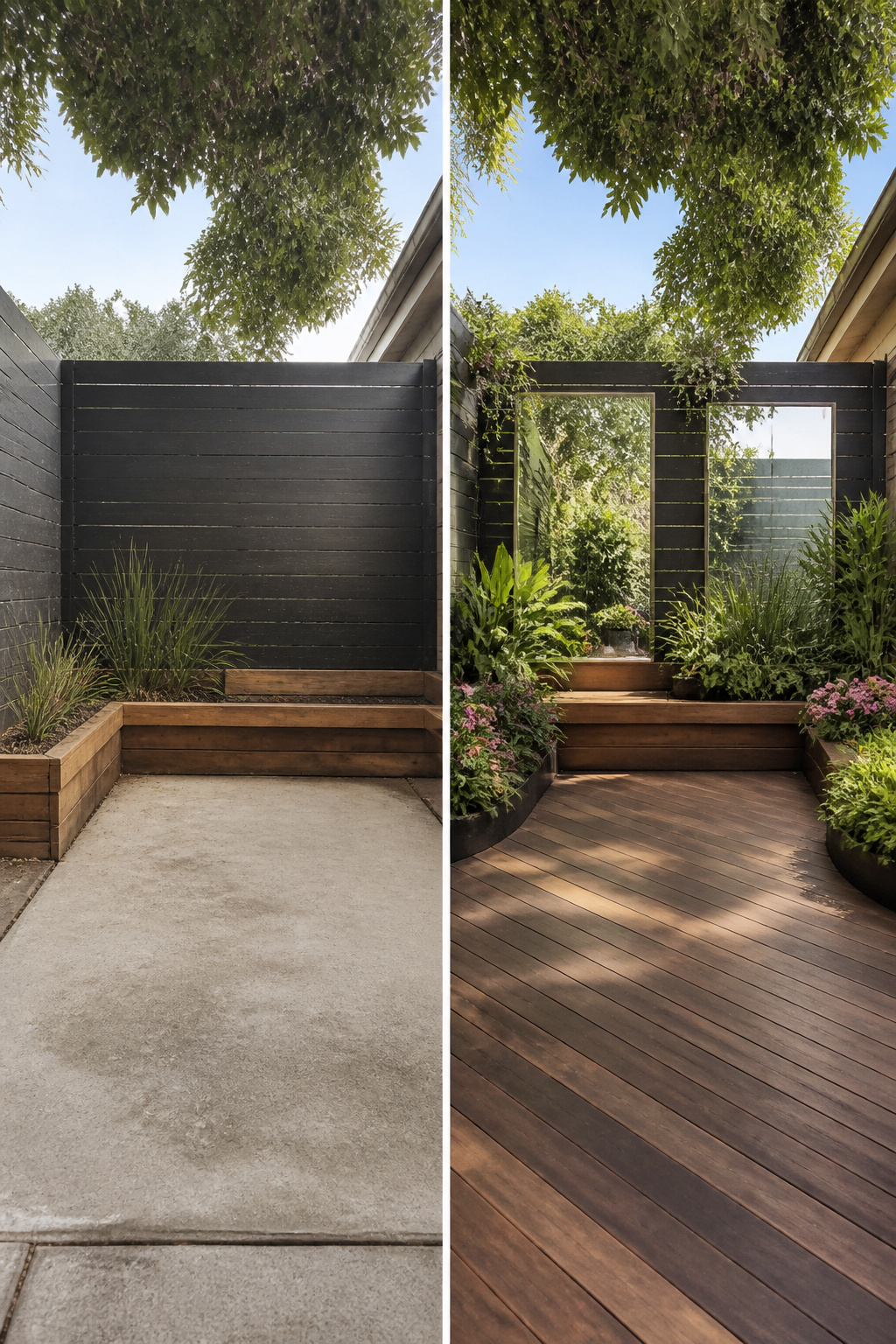
A small backyard reads larger when the eye has fewer borders to hit. Run decking or pavers on a diagonal and the rectangle of the yard dissolves; the brain stops measuring fence to fence and starts following the longer sight line. I keep the angles parallel, never a jumble of different ones, or the space feels fussy instead of open.
Mirrors do the same work indoors, and they work outside too. A framed mirror placed to catch greenery reflects borrowed depth; the yard doubles without adding a square foot. I would mount it where morning light hits foliage, not bare fence, or the illusion fails.
Color discipline matters more than color choice. Two or three main shades repeated through plants and hardscape, plus white or gray as neutral, keeps the eye calm. Five competing colors make a small space feel like a storage lot.
Plant height is the counterintuitive one. Low plantings at the edges, taller material in the middle, layers the view so the perimeter seems to retreat. The standard tall-in-back rule is for borders; in a confined yard, pulling height forward builds a false horizon. The center stays usable, the edges frame rather than fence in, and the whole thing reads as intentional rather than cramped.
5. Go Vertical with Your Garden
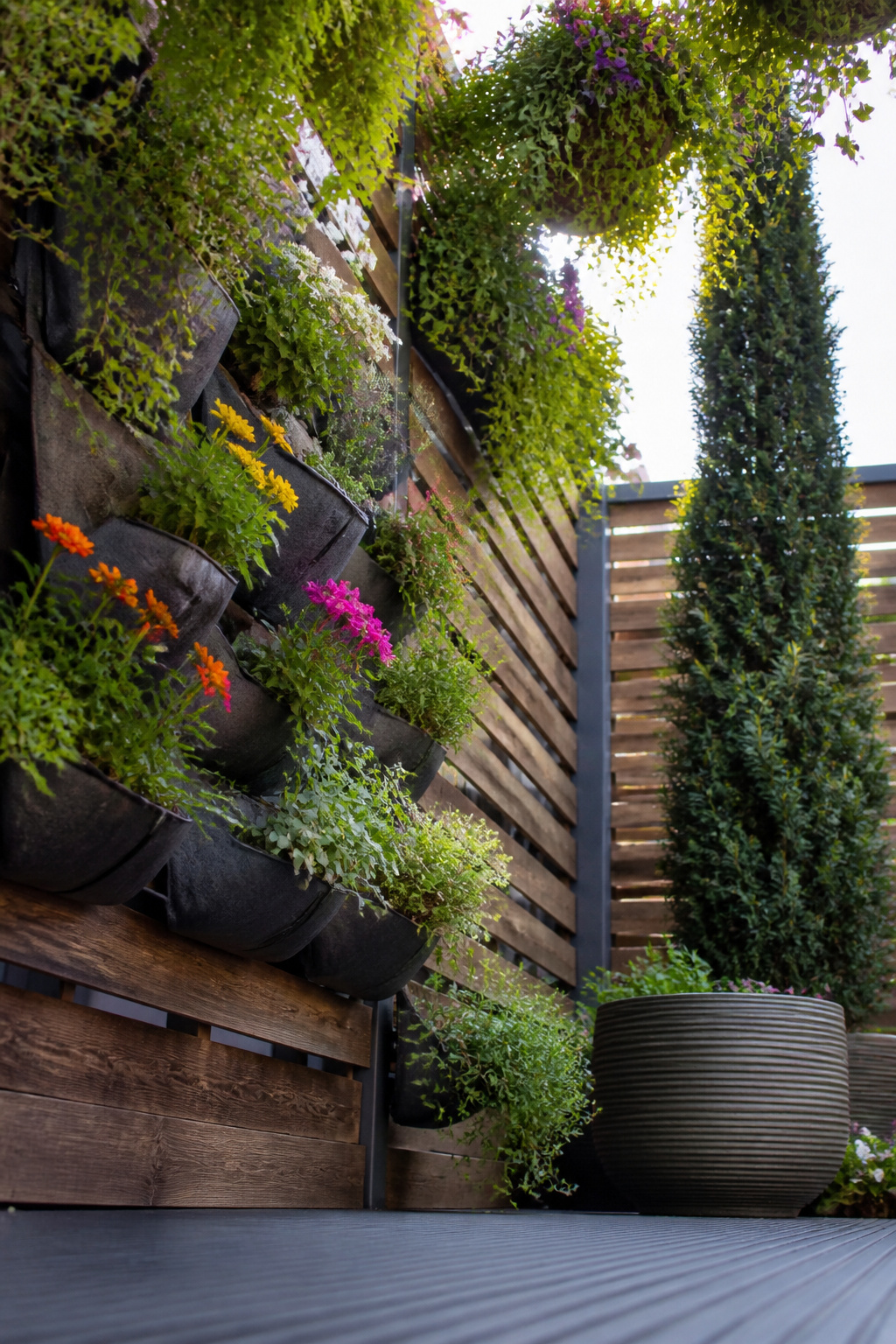
Wall planters and trellises turn the surfaces you already own into growing space, which matters when every square foot of ground counts for walking, grilling, or just stretching out a chair. A cedar or composite wall planter holds up through seasons and looks finished enough for a small patio that faces the neighbors; felt pocket systems weigh less and drain on their own, so a fence that flexes in wind won’t slowly lean under load.
For height without width, Sky Pencil Holly gives you 8–10 feet of evergreen at only 18 inches across, a narrow column that reads like architecture more than shrub. Espaliered fruit trees do similar work against a wall or rail, their branches trained flat so they take maybe six inches of depth while still flowering and fruiting.
Hanging baskets overhead free the ground completely, though a balcony rail planter is where you learn what weight actually means. Saturated soil in a metal or ceramic box adds up fast; the moment the rail starts to bow or the bracket slips, you have already passed what the structure can honestly take. Felt or fabric pockets on a rail weigh less and spill less, and that difference is what lets you sleep through a rainstorm.
6. Try a Pergola
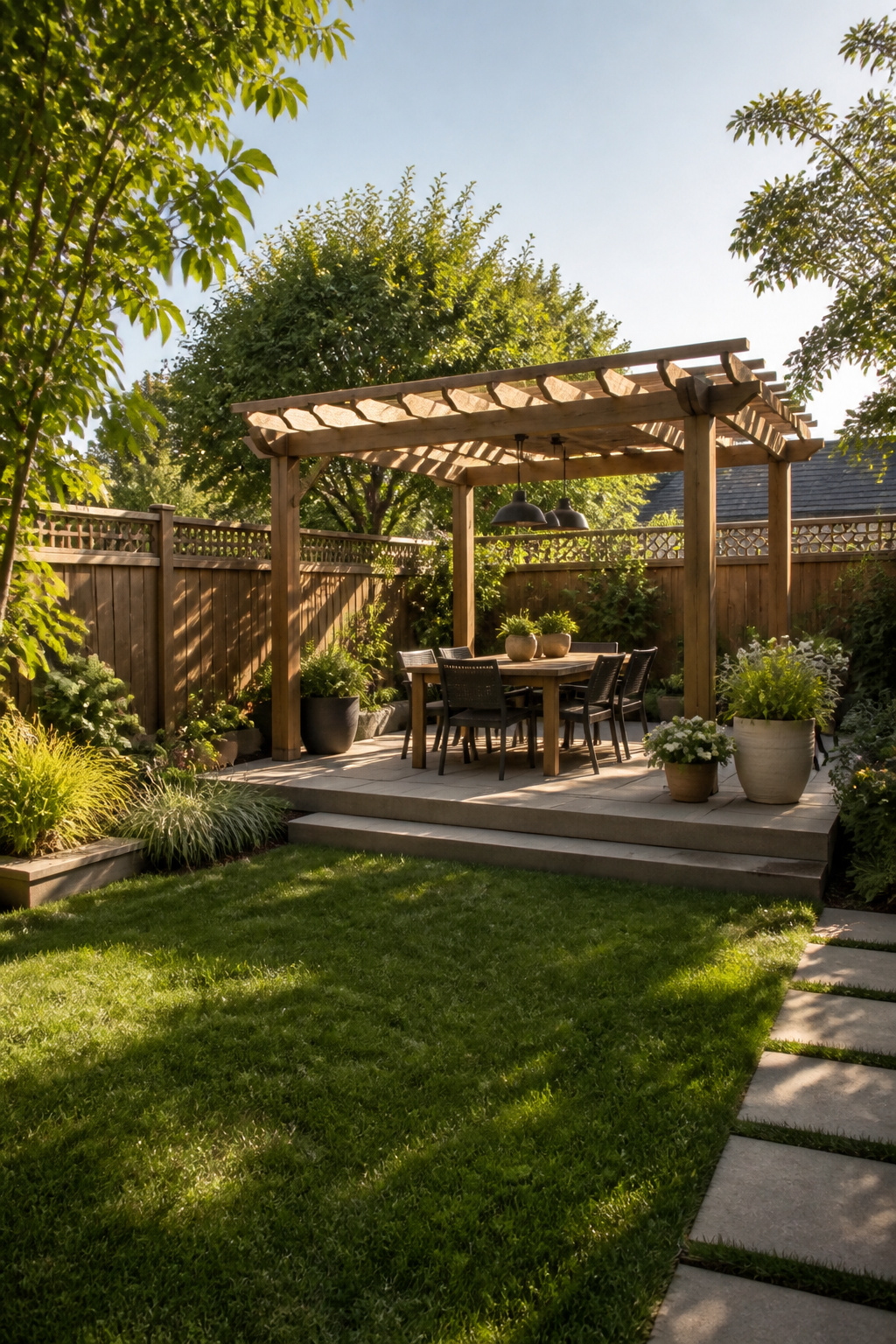
A pergola gives you defined shade without the solid feel of a roof pressing down on a small space. The slatted top blocks enough midday sun to sit underneath, but light still slips through, and air keeps moving. For my own install I went with a standard 10×10 cedar kit, the kind every big-box store stocks alongside 8×8 and 12×12 sizes. Materials and a helper for the day ran about $1,200 total. The first version I anchored straight to the deck posts, which seemed logical until the wood started flexing and the whole frame worked itself a quarter-inch loose over two seasons. I now set posts into concrete piers that sit below frost line, independent of whatever deck or patio is nearby. It costs an extra Saturday and two bags of mix, but the structure quits shimmying every time the wind picks up. If your backyard is truly tight, the 8×8 still covers a café table and two chairs without eating the lawn.
7. Create Outdoor Rooms or Zones
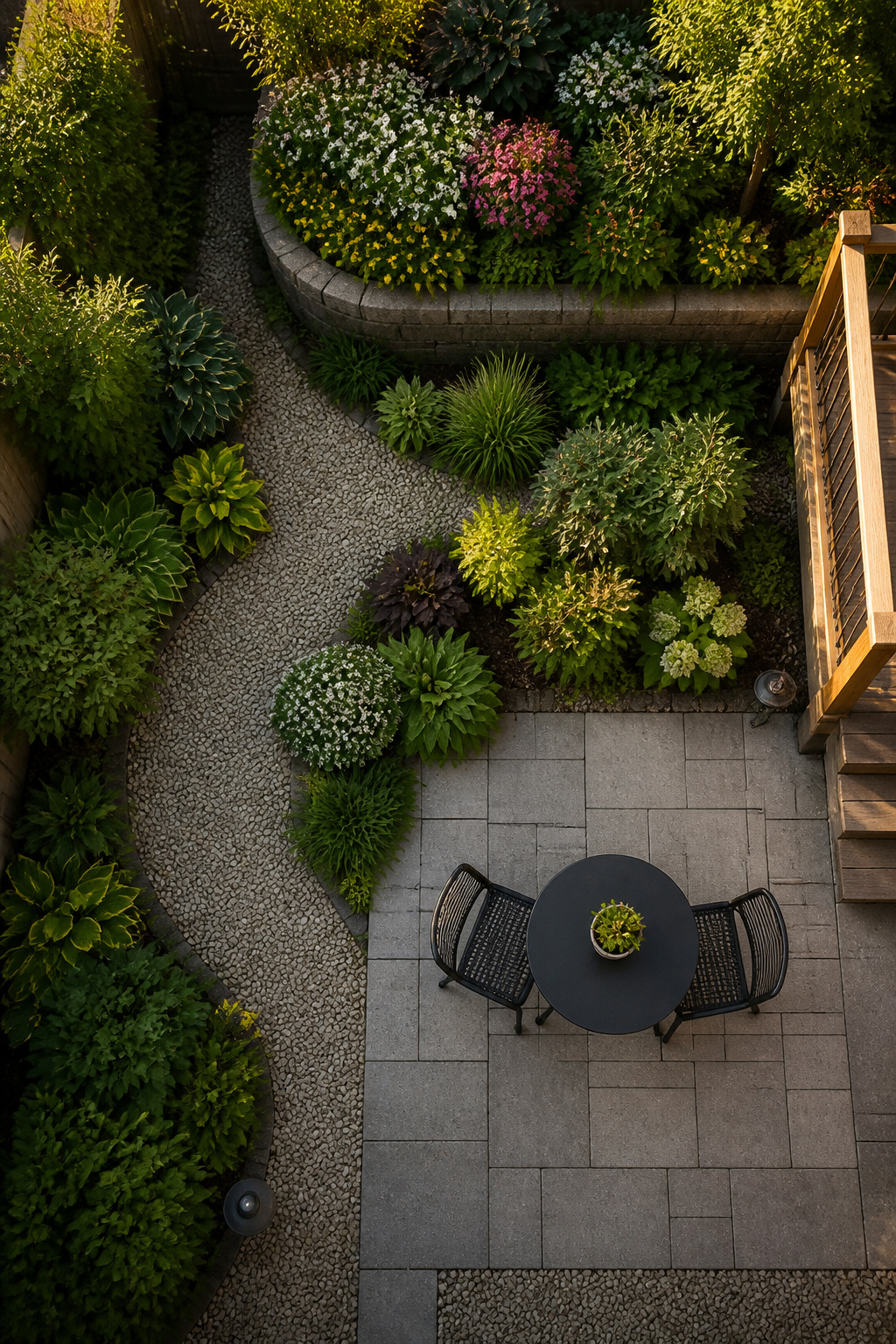
A 12-by-16 foot backyard can hold three zones if each is defined by a surface change. That is roughly enough room for a 6-by-8 foot seating area on pavers, a 4-foot gravel path, and a 5-by-12 foot perimeter bed. The math only works because the eye reads the material shift as a wall; the space between them still flows.
The mistake is making zones too small to actually use. A bistro table needs 5 feet of clear backing to pull a chair out. Anything tighter becomes a display you walk past, not a room you sit in. I have laid out yards where the owner wanted four "rooms" in that same 12-by-16 footprint and ended up with four awkward thresholds and nowhere to be.
Stronger geometry wins in tight quarters. Curves read as fussy unless they serve a clear purpose; rectangles and repeated shapes look intentional. Anchor one zone near the house for dining, run a visual axis through the center, and soften the perimeter with layered planting. The center stays open; the edges do the work. That perimeter framing expands the sense of space without taking any of it away.
8. Choose Plants to Reflect the Space
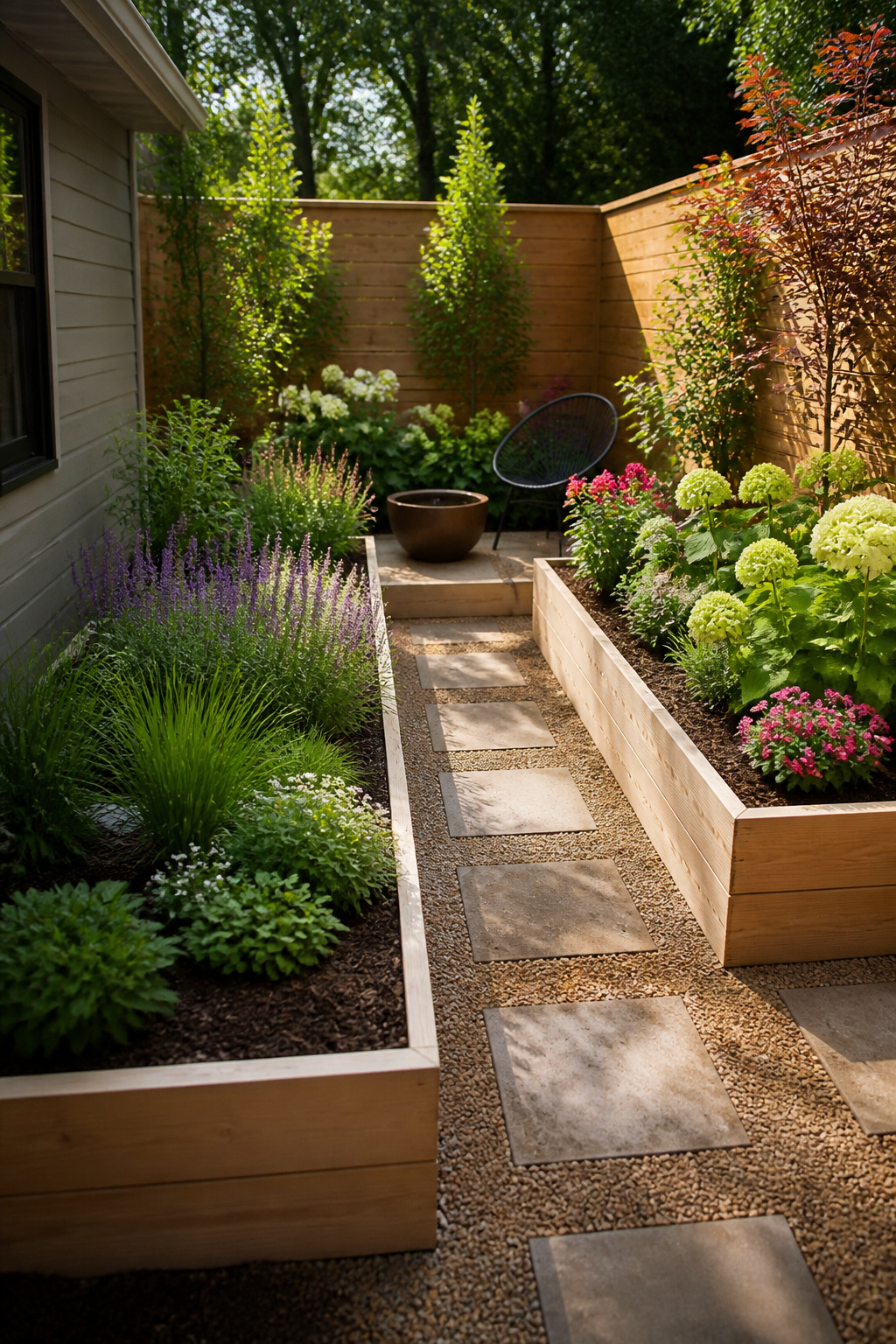
Compact shrubs and dwarf varieties read full-size in photos but stay under four feet at maturity, which is the only way to keep a small backyard from feeling overrun by October. I learned this the hard way after planting a nursery pot of ‘Green Velvet’ boxwood that the tag swore was "compact," then watching it swallow a three-foot path within five years. True dwarfs like dwarf boxwood or clump-forming ornamental grasses earn their place because they repeat cleanly across a bed without demanding constant pruning.
Raised beds make the most of tight square footage, though depth trips people up. Build 10–12 inches deep for most vegetables and herbs, and 18 inches for root crops like carrots or parsnips. Anything shallower and you’re buying potting soil for a container that behaves like one, with roots hitting the bottom and stalling. Edibles also need their six to eight hours of sun to produce, so track your light before you commit to placement. A bed tucked against a north-facing fence looks tidy in March and yields nothing by July.
Multi-season plants matter more in a small space because every square foot has to pull weight through winter. A compact evergreen shrub or repeat-flowering perennial contributes structure when the annuals have turned to straw. I now plan beds around one or two focal plants, a handful of structural repeats, and one ground-layer strategy. The restraint reads as intention; the alternative reads as clutter you have to prune back into coherence every spring.
9. Get Creative with Furniture
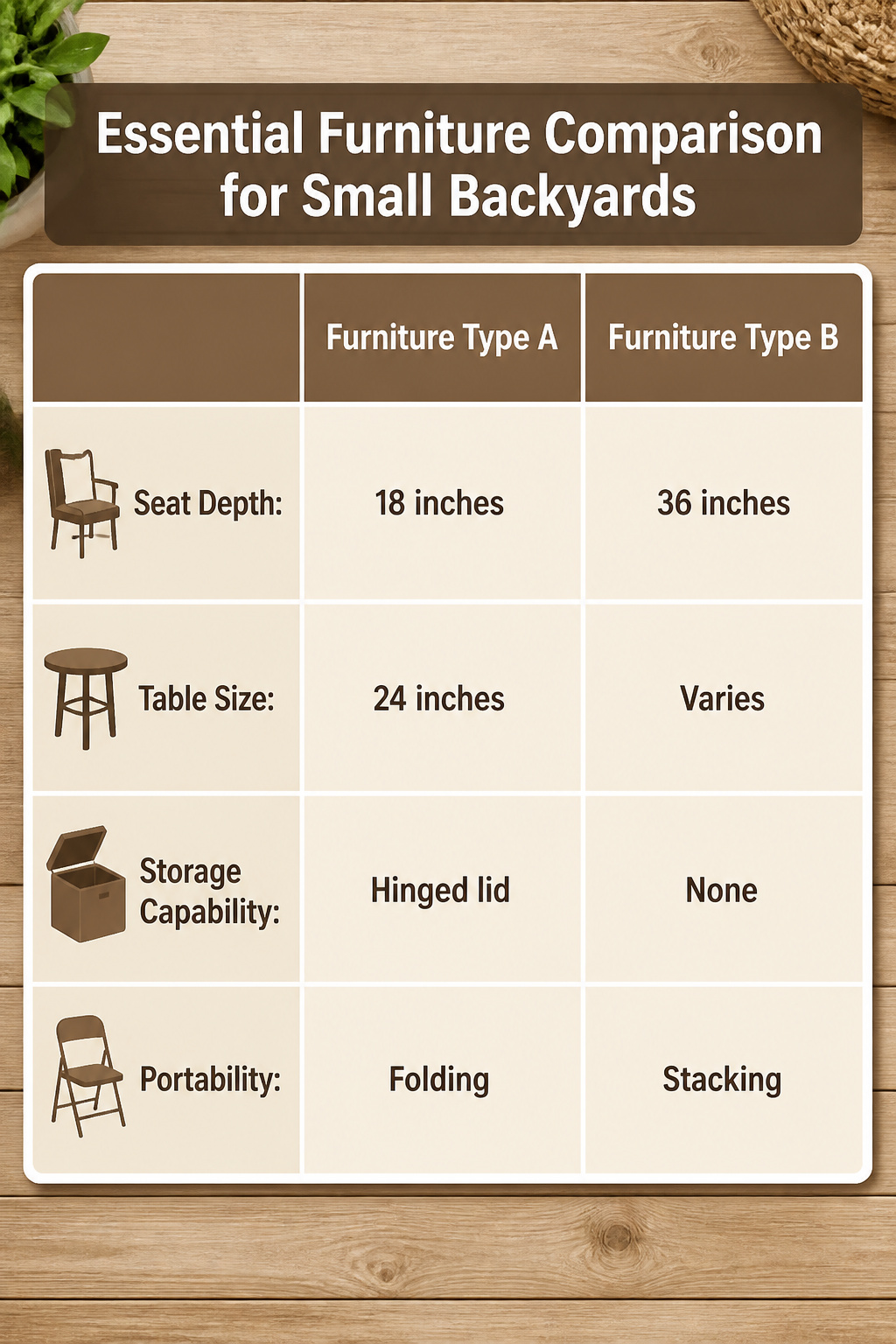
Multifunctional furniture is where a small backyard lives or dies on the numbers. An 18-inch seat depth is the threshold that lets a dining bench sit flat against a wall and still leave room for knees; anything deeper steals walkway that a narrow yard cannot spare. I learned that after a $400 sectional arrived with a 36-inch depth that blocked the only path from the door to the grill. It went back the same week.
Round side tables at 24 inches across slip between chairs when guests leave and stack two-deep in a shed corner. The storage kind, with lids that lift on hinges, hide cushions from weather without a separate deck box eating four square feet. Folding chairs that hang flat on garage hooks cost half what stacking resin ones do and leave the patio open for morning coffee.
The tradeoff is motion: every piece that nests or collapses asks you to move it. A bench with built-in storage stays put, but the lid needs clearance to open. Plan for the open position, not the closed one, or you will shuffle the same sectional problem into a smaller box.
10. Choose Sustainable Design Practices
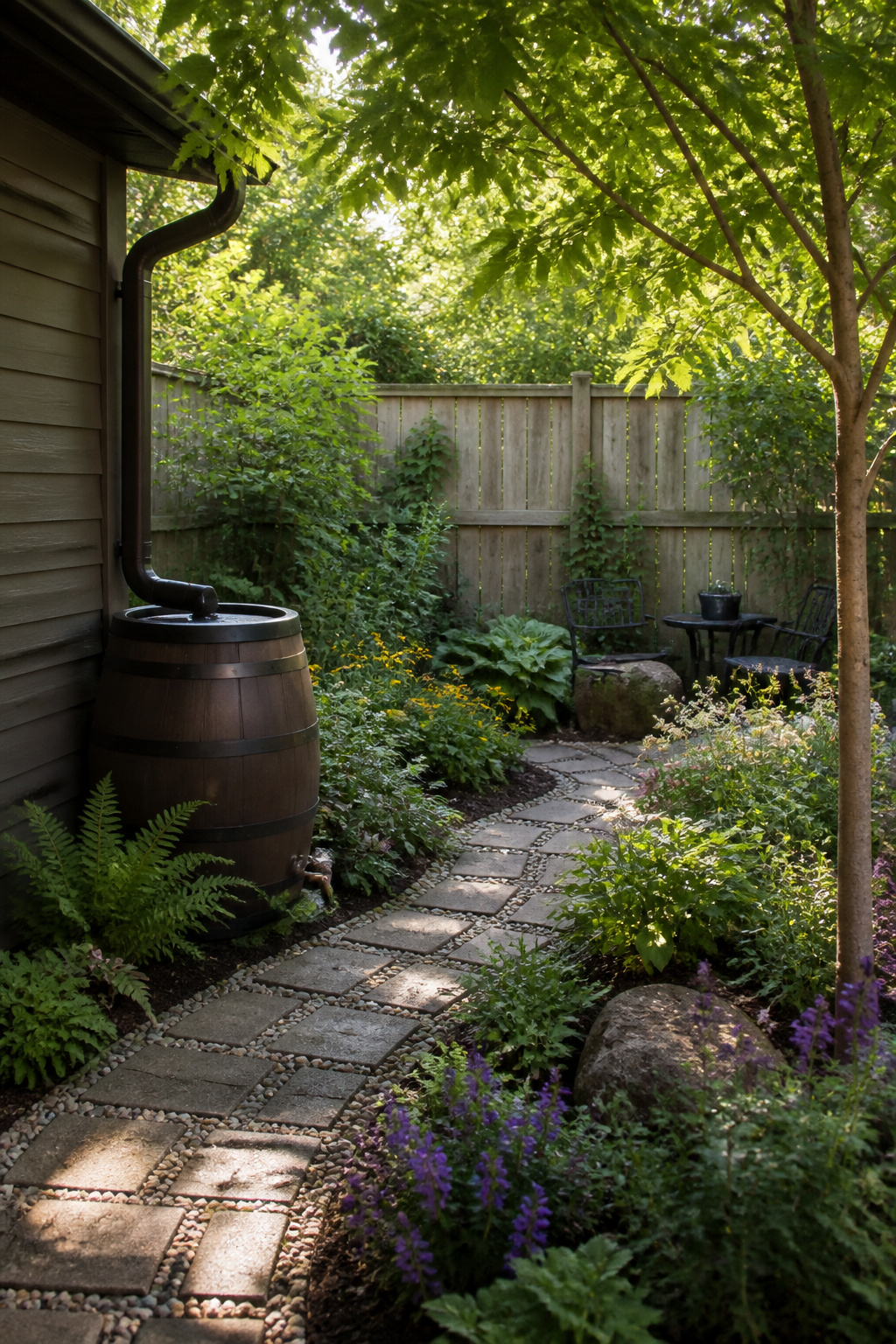
Sustainable design in a small backyard is less about statement pieces and more about shrinking the chore list. Native plants do the heavy lifting here. Three summers ago I swapped my thirsty border annuals for a trio of native shrubs, and my summer watering dropped from twice daily to twice weekly. The plants had evolved for my soil and rainfall, so they did not need me standing there with a hose to survive July.
Xeriscaping gets misunderstood as cactus and gravel, but in a wet climate it means grouping plants by water need and choosing permeable surfaces that let rain soak in rather than run off. Permeable pavers fit that logic: they give you a usable patio while keeping water out of the storm drain. Rain barrels stack onto the same system, catching what the pavers let through for the few plants that still need a drink.
Artificial turf comes up in this conversation, and I will say plainly that I skipped it. The upfront cost and the summer heat radiating off synthetic fibers did not match the low-maintenance promise I was after. Native shrubs and a narrow gravel path cost less, cool faster, and looked intentional within a season.
11. Add Water Features
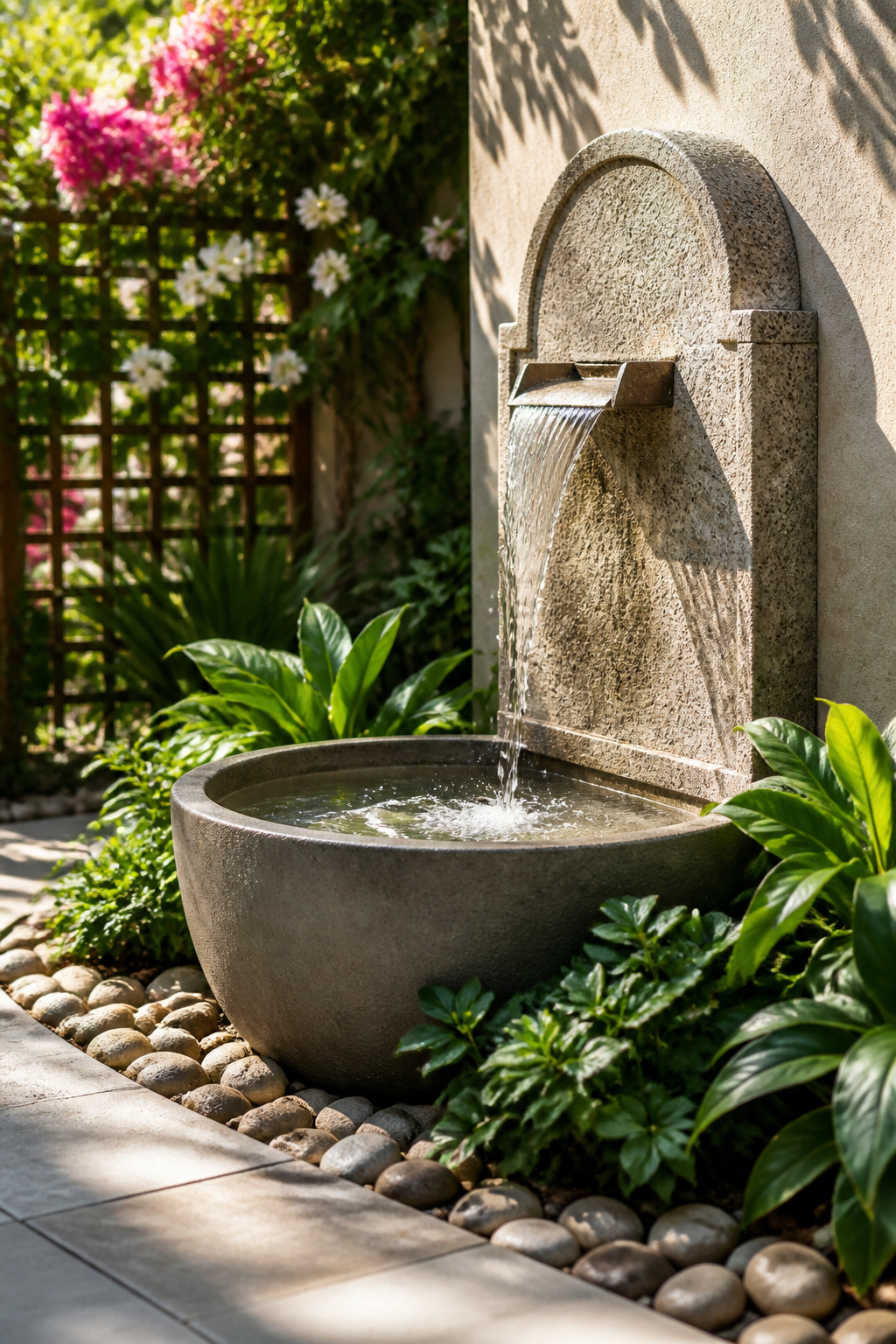
Moving water changes how a backyard feels even when you are not looking directly at it. The sound covers traffic, and the motion catches light in a way still water never does. In a small space, the trick is choosing a feature that gives you that effect without eating the ground you actually use.
Wall-mounted cascades solve the footprint problem entirely. They hang on a fence or the house itself, so your square footage stays yours. Urn-style bubblers sit in a corner and ask for little more than a level paver underneath. A pre-formed liner pond can tuck against a border and still hold a few aquatic plants or small fish if you want that living element.
A 50-gallon minimum is what keeps a small pond clear without leaning on chemicals. Below that, the water heats and stagnates too fast for plants and bacteria to balance it. I learned the splash rule the hard way: my first fountain sat on a low basin with too much pressure behind it, and anything within 4 feet got a daily misting. The fix was a taller, narrower spout and a lower flow rate, which gave the sound without the soak.
Pumps run either solar or plug-in. Solar skips the cord but needs direct sun to keep pressure steady through an afternoon. Plug-in costs nothing extra to run and pushes water reliably, though you are routing an outdoor-rated cord somewhere dry.
12. Incorporate Lighting
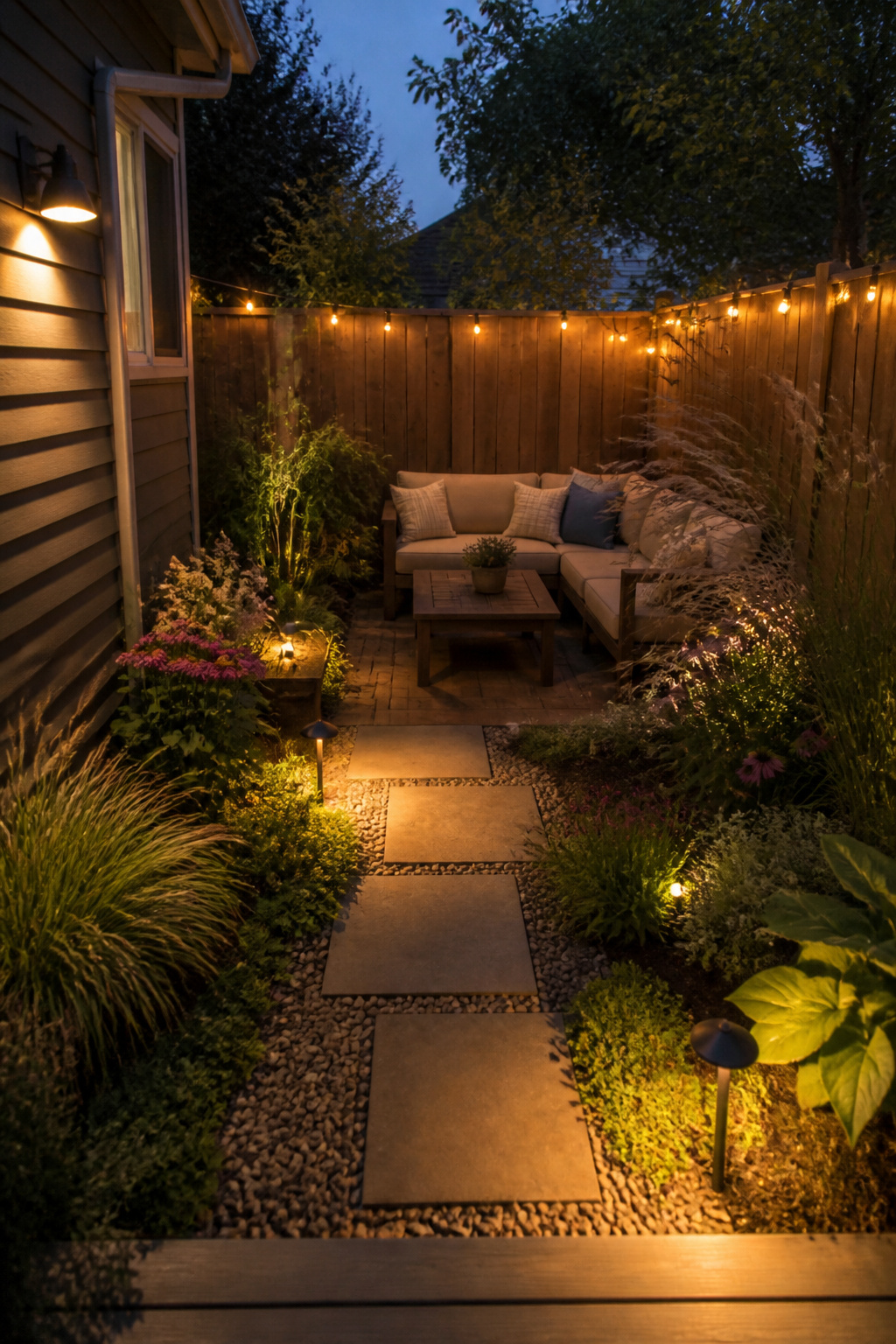
The best small backyard idea I found for stretching usable hours is also the easiest to overdo. Light belongs at the edges. One path light every fifteen feet is plenty; more than that and glare starts eating the space you were trying to open up.
Color temperature matters more than people expect. 2700K runs warmer, almost candlelight; 3000K is cleaner, closer to what you see in a hardware store aisle. I prefer 2700K for anything social, 3000K only where I need to actually see what I’m grilling.
Solar path lights were my first attempt. They died after one winter, the panels fogged and the housings cracked where freeze met thaw. I replaced them with a low-voltage setup: an $80 transformer, a hundred feet of 12-gauge cable, and two spotlights aimed up at the fence boards plus one run of string lights kept to the periphery, not draped over the main seating view. That transformer has run three seasons now without a flicker. String lights overhead can feel magical, but the black cable left hanging through daylight shrinks a small yard visually. Keep them to the sides, or accept that the tradeoff is worth it only on nights you’re actually out there.
Built-In Seating That Saves Space
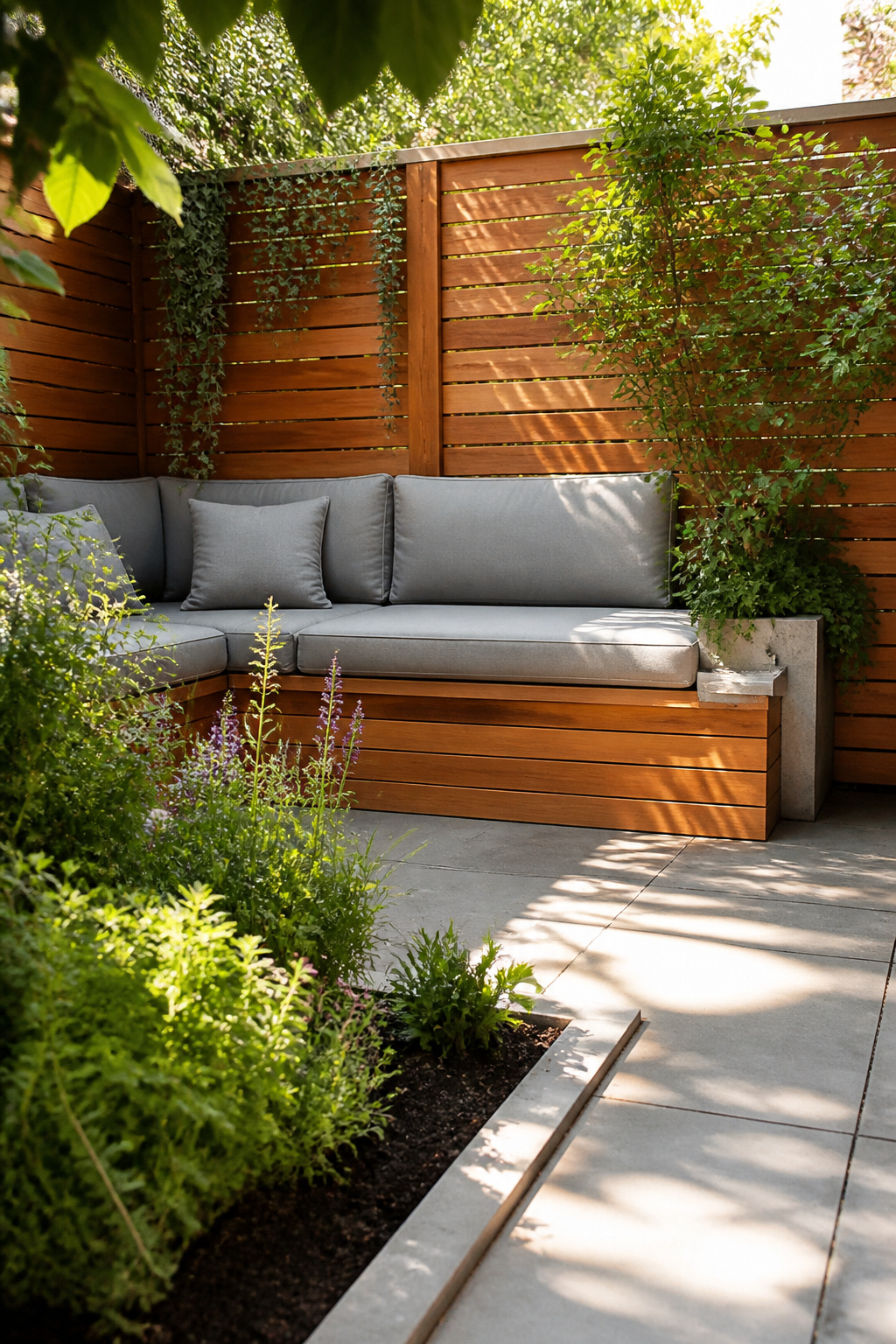
Built-in seating along a fence or retaining wall eats up zero clearance, which is the whole point in a yard measured in square feet rather than acres. The seat needs to hit 18 inches from ground to top for most adults to plant their feet flat without feeling like they’re perching on a barstool. I wrapped two-inch foam in Sunbrella for the cushions, and four years of afternoon sun and spring rain later the fabric hasn’t faded to that washed-out pink you see on cheap patio sets. My last bench was an L-shape in cedar, two boards deep with 2×4 legs anchored to the wall behind it. One hundred eighty dollars in lumber and exterior screws, one Saturday with a miter saw, and the thing doesn’t shift when three people pile onto one end. The mistake I nearly made was forgetting the slight back tilt. A flat back against a fence feels like sitting in a hallway; five degrees of angle changes it into somewhere you actually stay.
Outdoor Showers and Other Small Luxuries
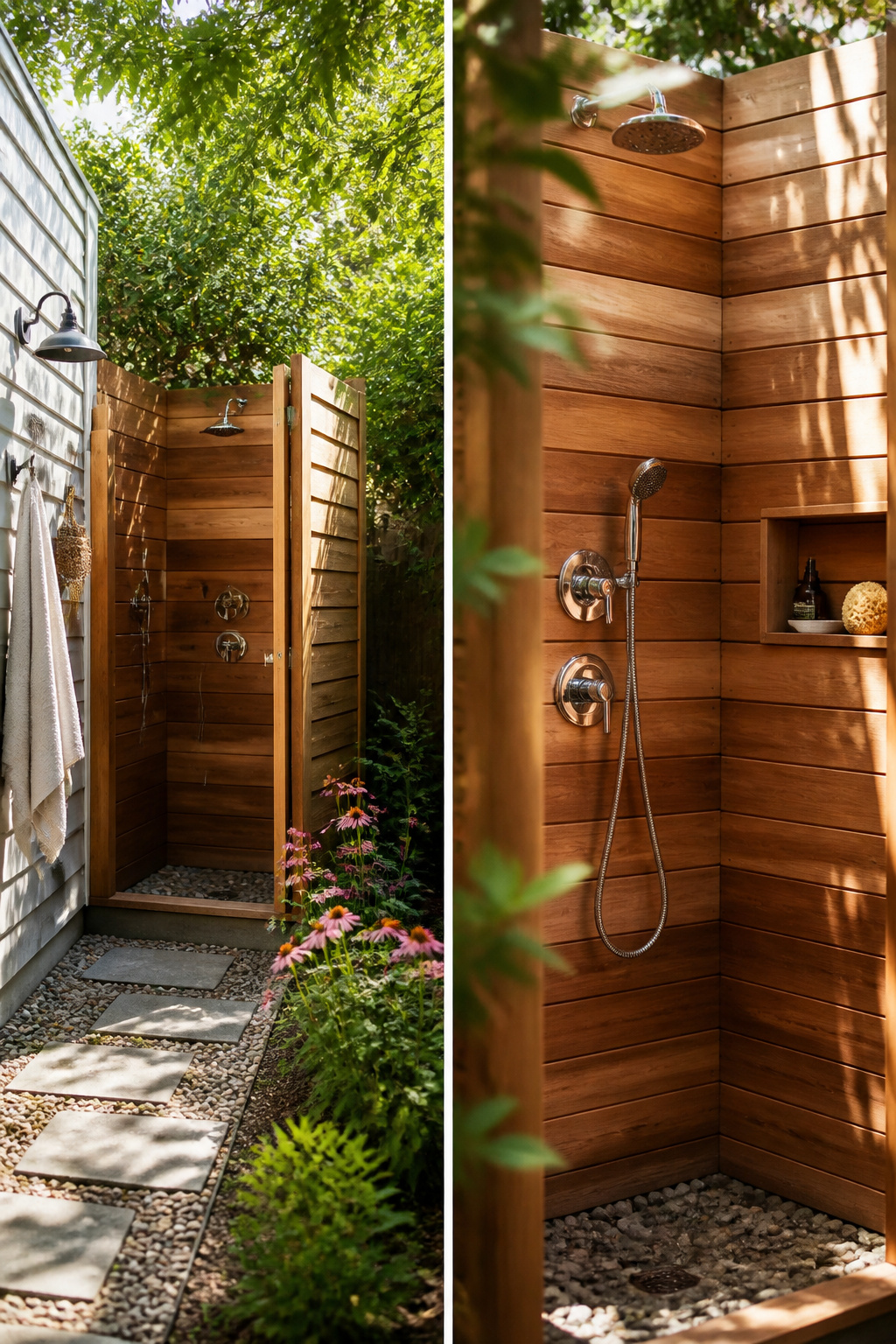
The outdoor shower I put in last summer started as envy. I stayed at a rental in the Texas Hill Country that had one plumbed straight off a hose bib, and after three days of rinsing off before walking inside, I knew I needed the same setup at home.
Mine cost under $350. I ran a brass splitter from the existing spigot, buried a half-inch PEX line three inches deep in flexible conduit, and mounted a simple chrome valve on a cedar post. Three six-foot cedar fence panels, hinged so they fold flat in winter, give enough privacy without a permit. The panels are just braced with 2x4s and deck screwed into the post, nothing permanent.
This only makes sense in two spots: beside a back door so you are not tracking mud through the kitchen, or beside a pool where a rinse saves your filter. Do not put one where runoff pools against your foundation or where you already fight mosquitoes, because damp shade breeds them faster. Mine sits on a bed of pea gravel over sand that drains in minutes, and that drainage mattered more than the fixtures.
Fire Pits and the Clearance Rules That Matter
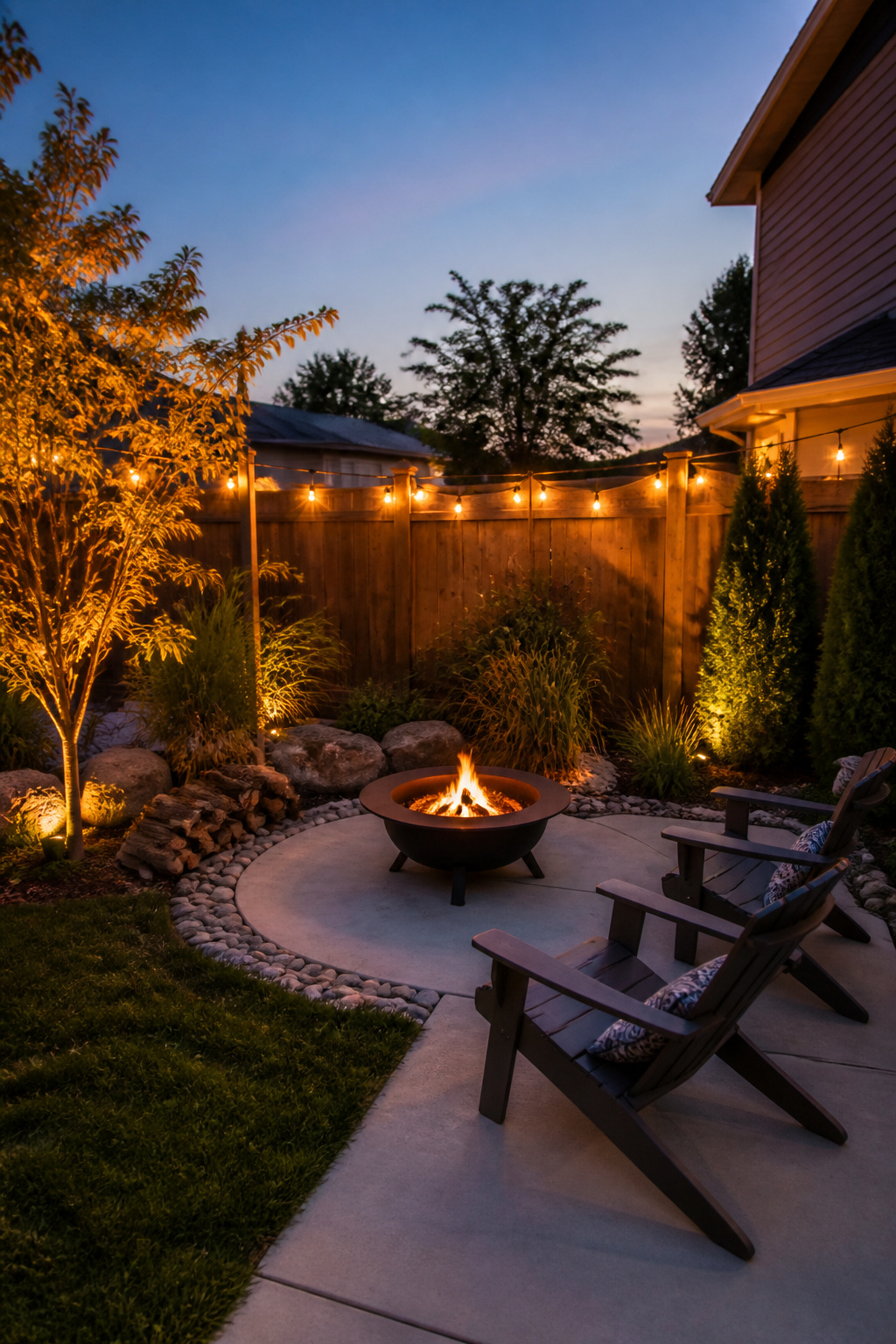
The 10-foot minimum from structures, fences, and overhanging branches exists because flame climbs faster than you can react. I learned that the hard way once, and the scorch marks on my neighbor’s cedar fence still remind me every spring. Keep ten feet clear in every direction, minimum, and check your local fire codes before you dig or even place a bowl; some towns treat portable and in-ground features differently, and the permit you skip is the fine that finds you.
Portable firepits suit small yards because they move. A 30-inch diameter bowl seats four people without crowding, and when the kids need that same concrete pad for chalk, you roll it aside. Gas or wood, charged hose within reach. I used to think gas meant no ignition risk. Embers still happen. I keep the hose ready now.
A portable firepit can take up less than five square feet of space—and can be moved to the side on those days when the kids want to get creative with the chalk.
That portability is what makes it work for renters and anyone who might need the yard back tomorrow.
What I Spent on My Last Backyard Refresh
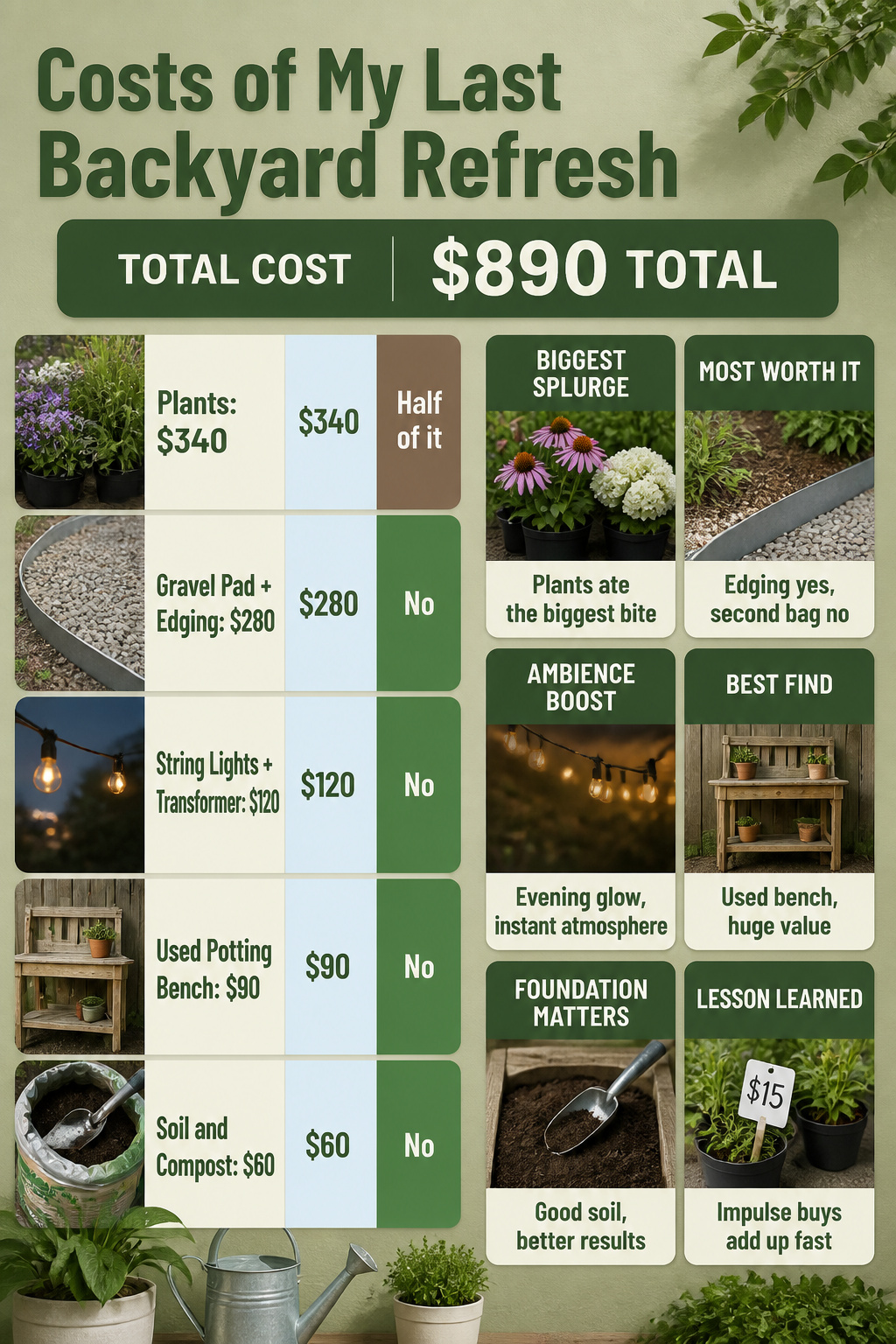
My last backyard refresh ran $890 total, and the breakdown is where the lessons hide. Plants ate the biggest bite at $340, though half of that was impulse buys at the nursery that looked smaller in the ground than they did on the cart. The gravel pad and aluminum edging came to $280; the edging was worth it, the second bag of pea gravel was not. String lights and a transformer added $120, a used potting bench from Facebook Marketplace $90, soil and compost $60.
| What I spent | Cost | Would skip? |
|---|---|---|
| Plants | $340 | Half of it |
| Gravel pad + edging | $280 | No |
| String lights + transformer | $120 | No |
| Used potting bench | $90 | No |
| Soil and compost | $60 | No |
One weekend of my labor, and the thing I would drop next time is obvious: those impulse plants. A $15 perennial in a 2-gallon pot looks like a deal until you need six of them to read from five feet away. The used potting bench, scuffed and missing a drawer pull, outperforms anything I have bought new.
Frequently Asked Questions
How can I make my small backyard look bigger?
Run decking or pavers on a diagonal so the eye follows a longer sight line instead of measuring fence to fence. Keep colors disciplined to two or three main shades repeated through plants and hardscape, plus a neutral. Place low plantings at the edges and taller material in the middle to build a false horizon that makes the perimeter seem to retreat. A mirror mounted where morning light hits foliage can also double the apparent depth by reflecting borrowed greenery.
What are some good plants for small backyards?
Choose compact shrubs and true dwarf varieties that stay under four feet at maturity, such as dwarf boxwood or clump-forming ornamental grasses. For height without width, Sky Pencil Holly reaches 8–10 feet at only 18 inches across. Multi-season plants matter more in tight spaces; compact evergreens or repeat-flowering perennials contribute structure when annuals have died back. Every plant should earn its place by doing more than one thing across the year.
How do I create zones in my small backyard?
Define each zone with a surface change rather than walls, using materials like pavers, gravel, and planted beds to separate functions. A 12-by-16 foot yard can hold three zones if each is large enough to actually use; a bistro table needs five feet of clear backing to pull a chair out. Keep the center open and let the edges do the work, with stronger geometry like rectangles rather than curves that read as fussy in tight quarters.