

An enclosed porch earns its keep only if it survives what the seasons actually throw at it. The pressed-wood drawer set that swelled shut after one August taught me that lesson fast, and the $350 portable heat pump that now runs four months a year proved the room could work harder than the house’s main HVAC ever would.
1. Cozy Seating That Survives the Seasons
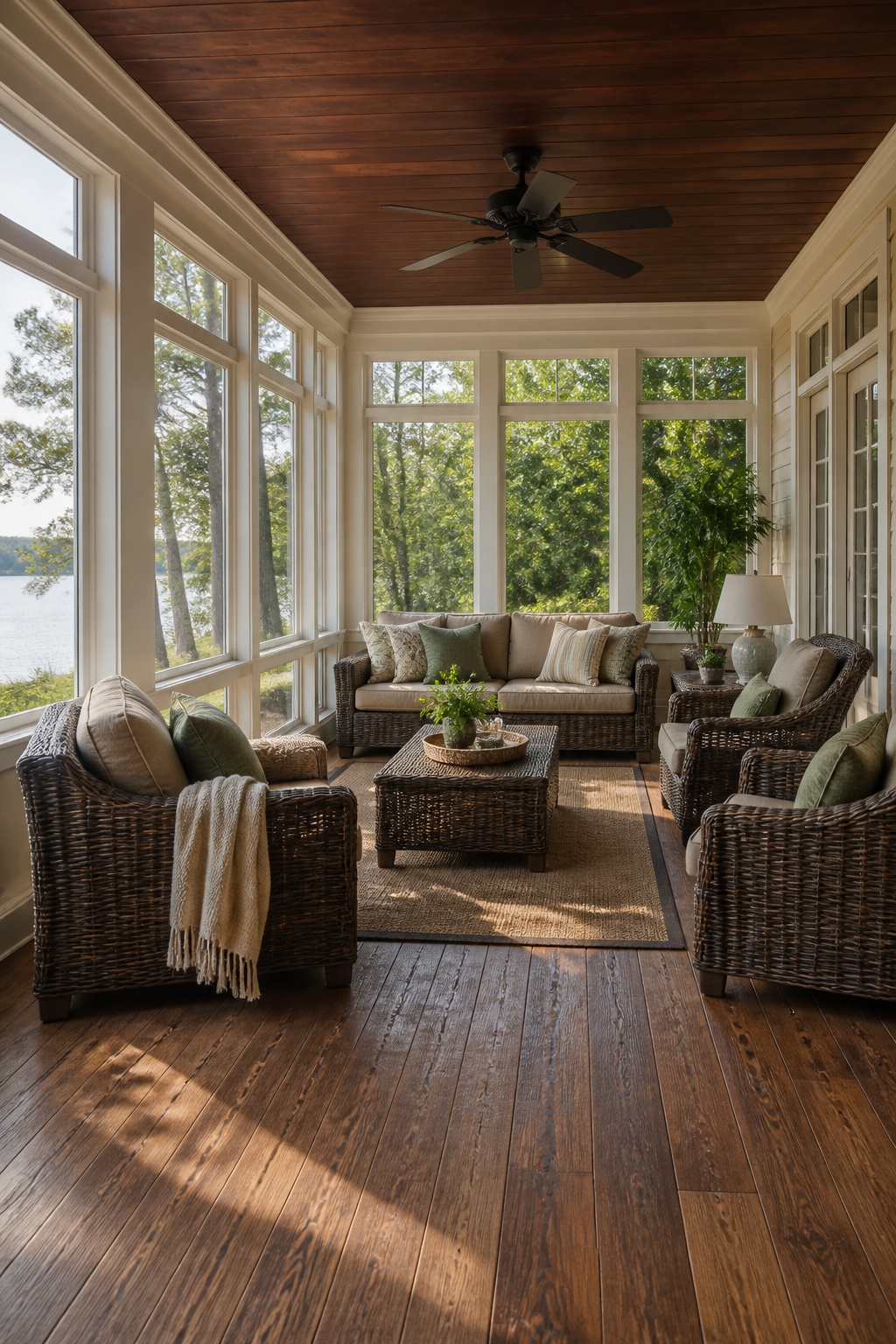
Deep seating sofas and lounge chairs built on wicker, rattan, or aluminum frames handle the humidity shifts that ruin standard indoor pieces out here. I learned that the hard way with a pressed-wood set that swelled shut its own drawers after one August. All-weather cushions solve the fabric side, but the frame material is where the real money goes, or does not have to.
Wicker and rattan give you the texture that reads "porch" without the maintenance bill, though they are not the same thing. Rattan is a solid vine; wicker is the weave technique, often done in synthetic resin now that fools the eye and laughs off rain. Aluminum is the lighter choice, easier to move when you need the floor for a project or a party, and it does not hold heat the way steel does in direct sun. The trick is finding pieces that feel like furniture, not patio afterthoughts, at a price that leaves room for the cushions.
Layer in blankets and throw pillows that you would not mind dragging inside if a storm blows wrong. The best setups look like you borrowed from the living room, not like a catalog spread waiting for a pool.
2. Greenery Without the Guilt
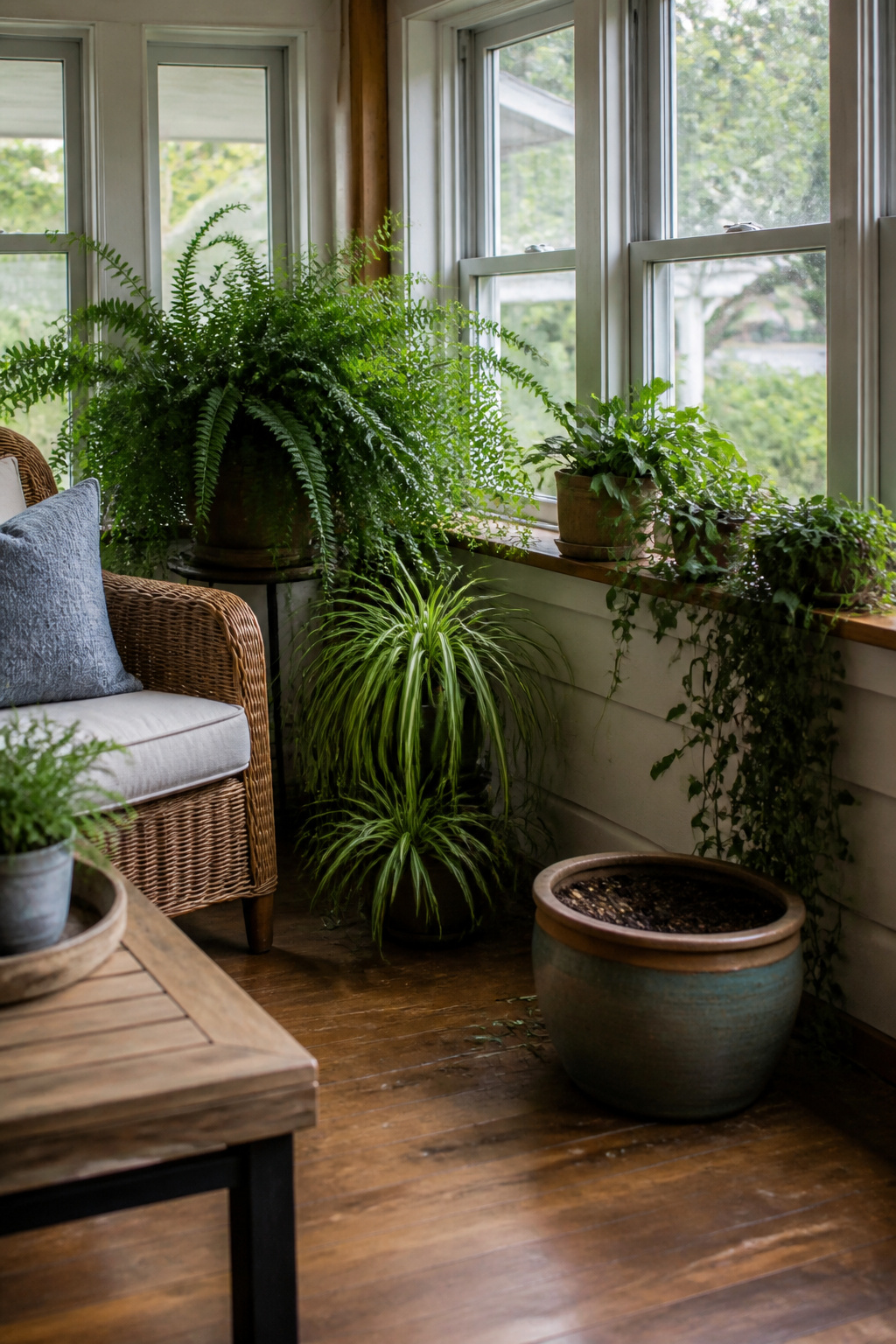
Ferns and spider plants are the only greenery I trust on an enclosed porch now. Both handle the dim, filtered light that comes through storm windows and the humidity swings that happen when a door gets left open in a rainstorm. A Boston fern in the corner by my screen door has survived two winters of me forgetting it exists, and the spider plant on the ledge just keeps dropping babies regardless of whether I rotated it.
The peace lily I tried before them was less forgiving. I watered it on the same Sunday schedule as my living room plants, and the porch air held that moisture differently. Root rot set in before the leaves even yellowed, and by the time I noticed the soil smelled off, the crown had turned to mush. Now I only water porch plants when the pot feels light, which in that slower-evaporating space means roughly half as often as the rest of the house.
3. Layered Lighting for Actual Evenings
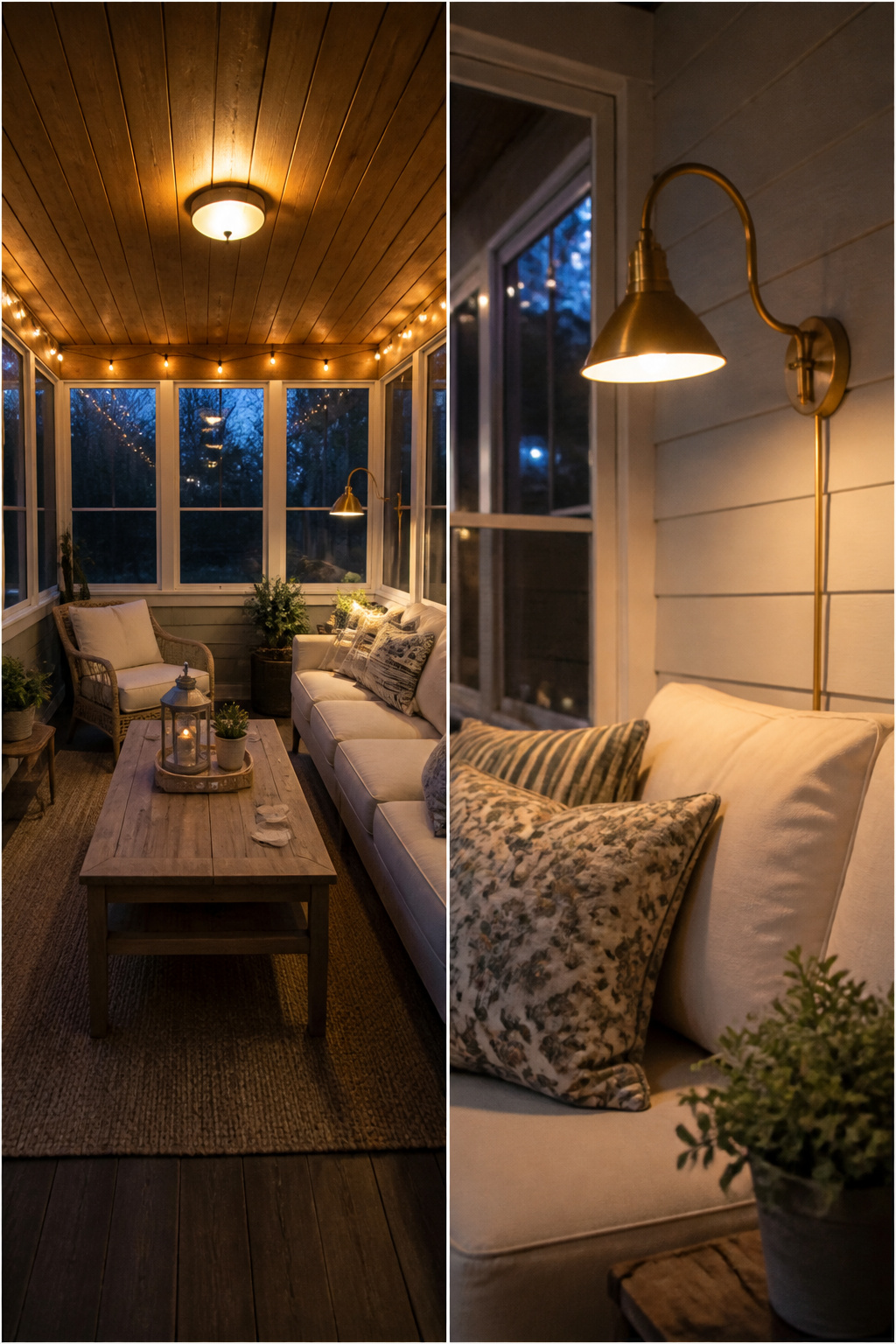
The first thing that died on my porch was the single overhead fixture I thought would be enough. It cast a flat, prison-yard glow that made the space feel smaller after sunset, and when the bulb finally flickered out in month three, the whole room went dark.
I rebuilt the plan around three layers. For ambient light, I hung a dimmable flush-mount near the center beam and wired it to a Lutron switch I bought at the local hardware store for about twenty-five dollars. Task lighting came next: a wall-mounted gooseneck arm over the chair where I read, wired to an outlet I already had. The accent layer was the slowest to arrive, a string of LED bistro lights along the header that I plug in only when people come over.
The accent fixtures failed first. The cheap sockets let moisture in during the first hard freeze, and half the strand went out by February. Spend the extra ten dollars on sealed, wet-rated sockets if your porch breathes at all in winter. The overhead still works, but I almost never use it alone now. Three sources at lower wattage beat one source at full blast every single evening.
4. Furniture That Works Double Shifts
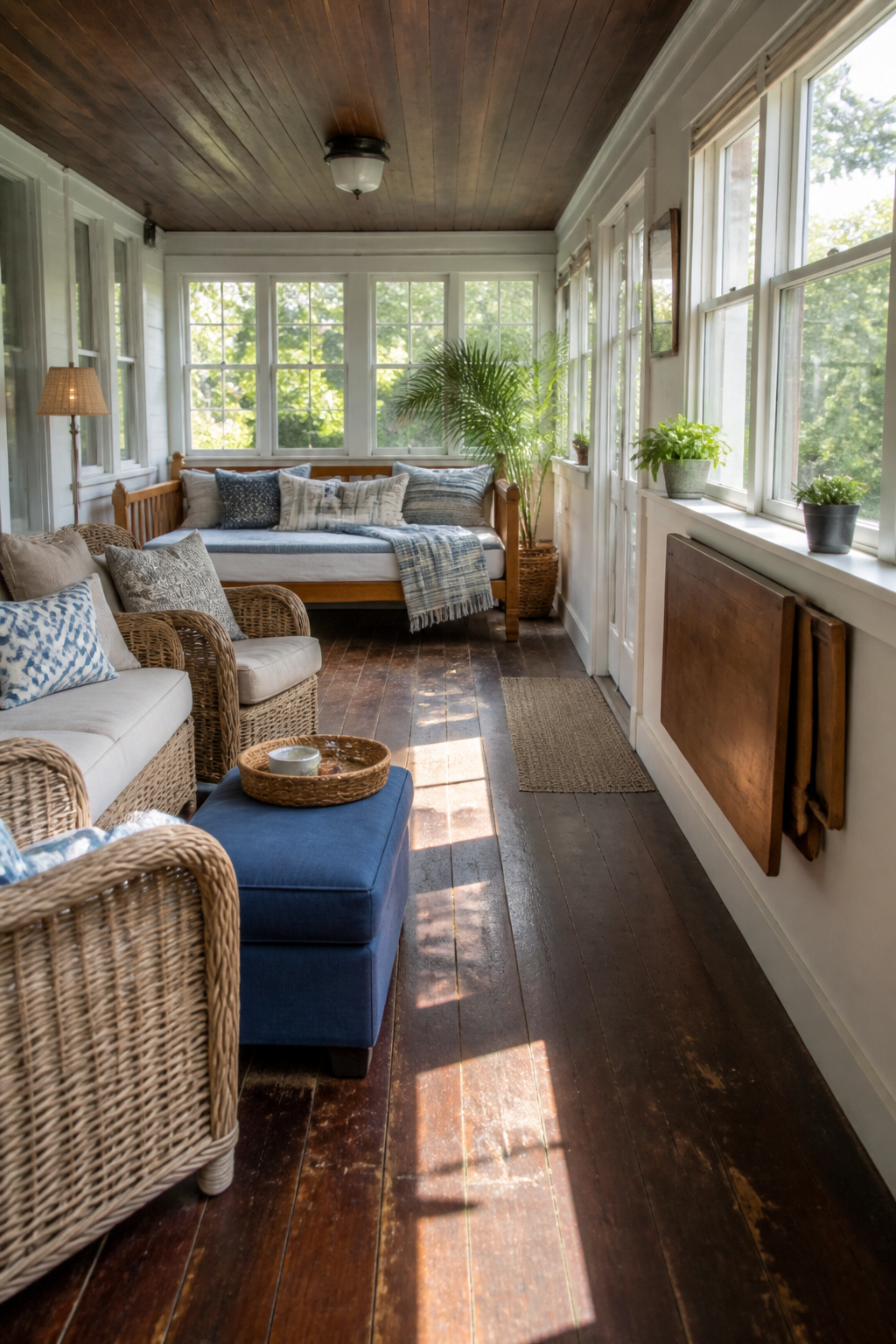
A 12 by 12 screened-in deck runs $10,000 to $20,000 in materials alone, so every piece inside it needs to pull at least two shifts. Storage ottomans handle the obvious: extra seating when the neighbors stay late, blankets and board games swallowed inside when they leave. I have watched a porch turn from conversation pit to guest room because someone chose a daybed frame deep enough for a real mattress, not the decorative kind that leaves legs dangling.
Wall-mounted drop-leaf tables earn their square footage by disappearing entirely. Folded up, they leave floor space for yoga or a project spread; dropped down, they hold dinner for two. The mistake is mounting too high, turning every meal into a shoulder workout. The Kadlec approach, twin beds that read as sofas by day, asks more of your budget but solves the "where does my mother-in-law sleep" problem without a dedicated guest room you do not have.
5. Personal Touches That Stay Personal
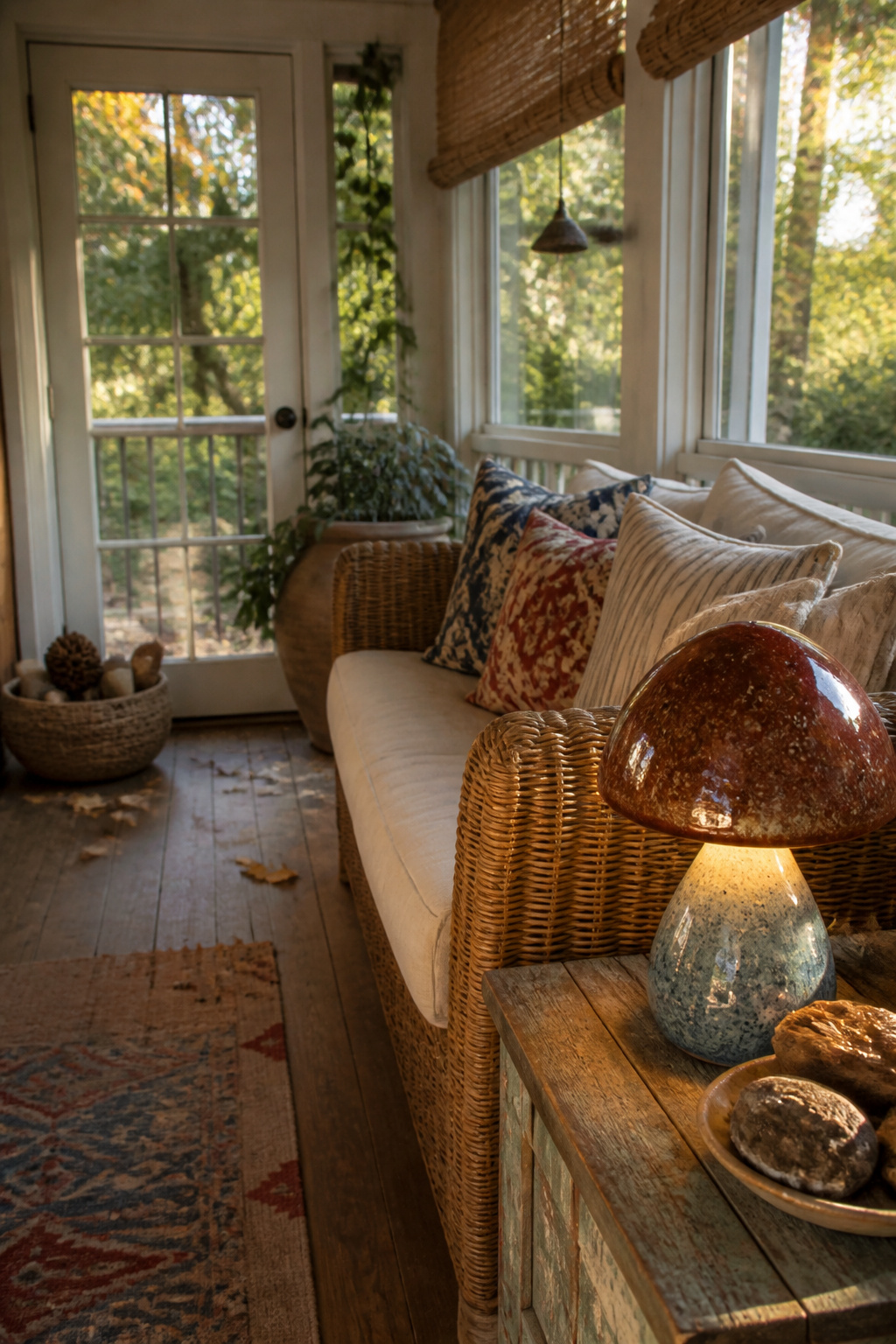
The three things that made the porch feel like mine came from places a showroom would never find. A ceramic lamp shaped like a mushroom sat on my old apartment’s fire escape through two winters; the glaze has hairline cracks that catch the afternoon light. I wired it for porch outlets myself, which took one Saturday and a $12 voltage tester. A wool blanket in a plaid I cannot name came from a garage sale in a town I was only driving through. The woman selling it had used it on her own screened porch for thirty years, and the moth holes are part of why I paid the six dollars. The third piece is a wooden crate I broke apart and rebuilt into a side table with a scrap of marble from a countertop job site. The weight is wrong for moving easily, so it stays where I put it. That limitation matters more than perfection. Nothing here coordinates, and nothing was bought as a set, which is exactly why the space reads as lived-in rather than styled.
6. Temperature Control on a Budget
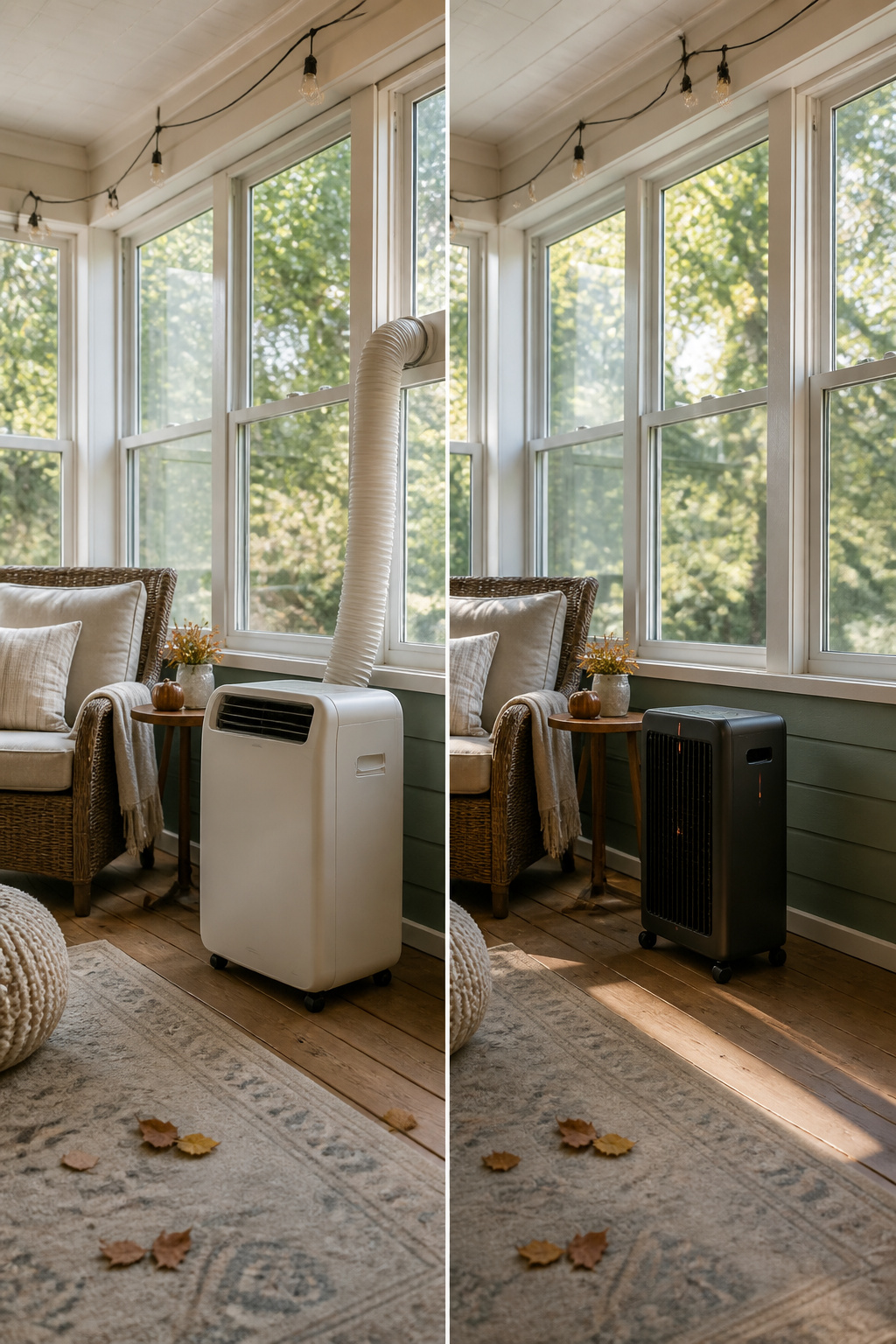
Portable heat pumps that slide on casters turned out to be the sweet spot for my three-season porch. I bought a 12,000 BTU unit with a window vent kit for around $350, and it both heats and cools the space without touching the house’s main system. The electric bill jumped about $40 to $60 a month during peak summer and winter stretches, which felt fair for a room I actually use now instead of avoiding.
Electric fireplaces with infrared quartz heating work better than I expected for dry winter air, though the realistic flame settings are mostly for show. Mine draws 1,500 watts on high, so running it four hours nightly adds up. I only light the fake flames when company comes over; the heat alone keeps the room comfortable without the theater.
For insect season, retractable motorized screens beat storm windows for airflow, but the motor and track system need a dedicated outlet and some clearance above the frame. Budget $800 to $1,200 if you are pricing them out. I skipped them after measuring my header height and realizing I would lose the curtain rod. Fixed screens with a removable lower panel turned out to be the compromise that left money for the heat pump instead.
7. Privacy Without Blocking the Light
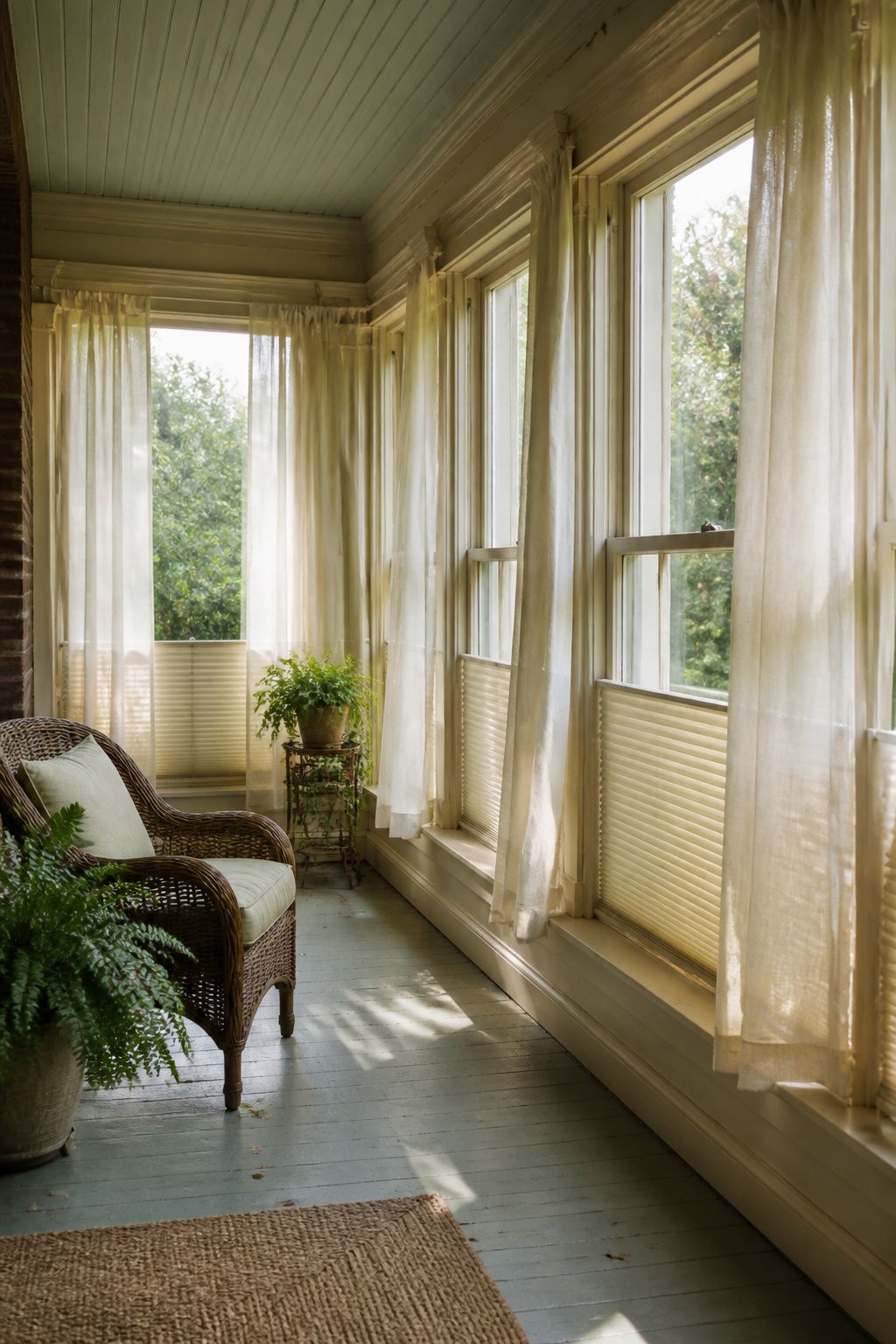
Heavy drapes on a porch are a quick way to make it feel like a basement apartment you are hiding from. I learned that the hard way on my first rental, where two layers of blackout curtain turned what had been a bright three-season room into something closer to a storage unit with a couch. The light died, the air felt stale, and the whole point of being in the porch, that half-outdoor hum, went flat.
Bottom-up shades fix this without the cave effect. You mount them at sill height and raise them from the base, which blocks the sightline from the neighbor’s yard or the sidewalk while the upper glass stays clear. Tension rods inside the frame let you layer a sheer or a light curtain without drilling into trim a landlord will notice. Frosted film on the lower panes works the same way, and it comes off with a hairdryer when you move.
The trick is keeping the hardware minimal. A slim aluminum headrail for the shade, a white tension rod, nothing that reads as window treatment from the outside. You want privacy that still lets the room breathe.
8. Tech That Belongs Out Here
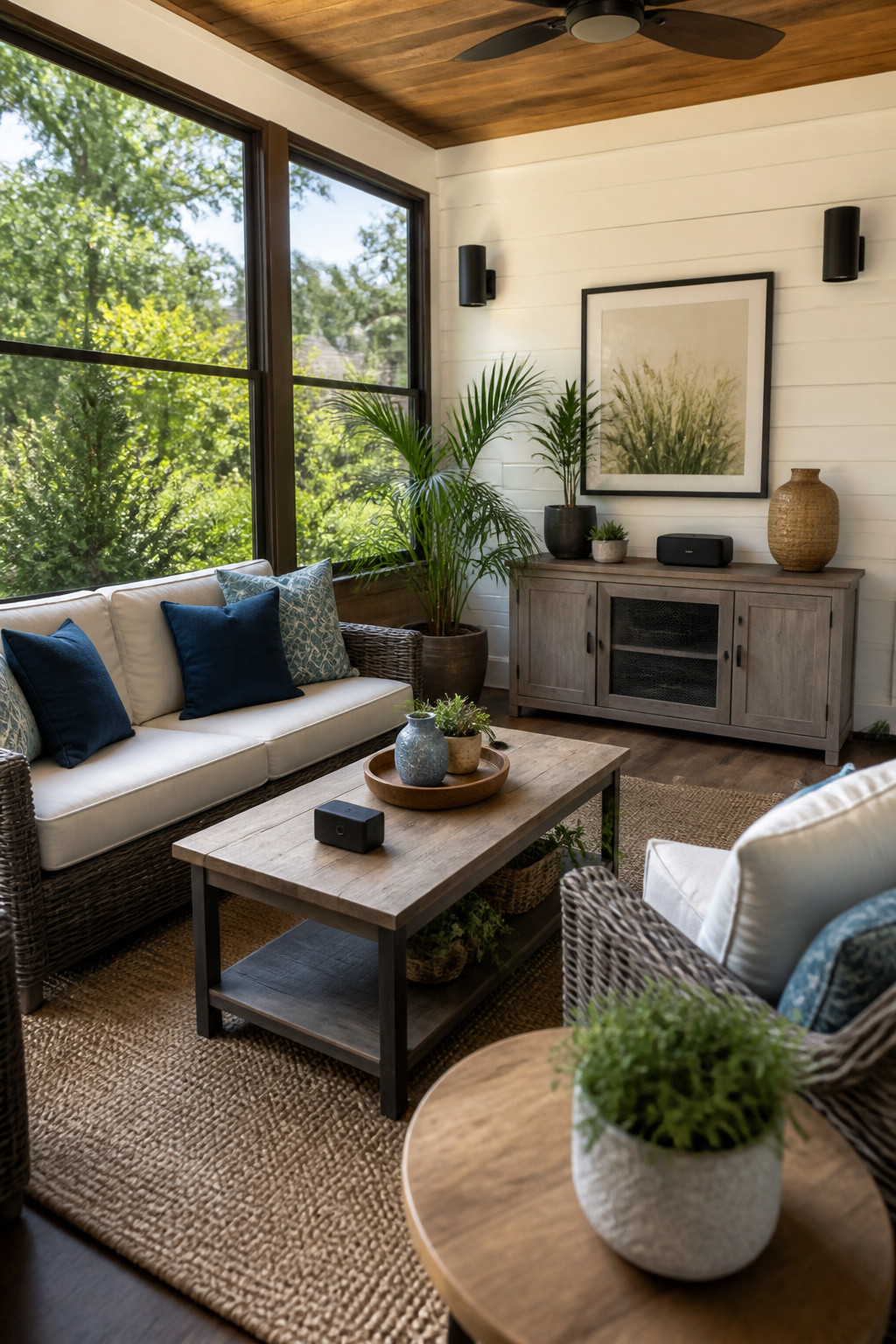
Weatherproof speakers were the only entertainment tech that made sense for my porch. I looked at outdoor televisions first, until I saw what a basic model costs and how fast moisture gets behind the screen seal in a space that is not fully climate-controlled. A speaker rated IP66 or higher costs a fraction of that, and rain does not care about your weekend.
The outlet was the real project. My porch had one interior-grade receptacle near the door, enough for a phone charger and nothing else. Running a new GFCI circuit through the exterior wall took most of a Saturday and about eighty dollars in parts, but it let me mount speakers where they actually fill the space instead of clustering everything by the house. I wired it myself because the run was short and the breaker panel was accessible; a spark friend checked my work, which I recommend over guessing.
Bluetooth range gets weird with walls and screens between you and the source. A small receiver hardwired near the speakers, with a line back to the indoor stereo, solved that without adding another app to manage. The whole setup runs under three hundred dollars and has survived two humid summers and one ice storm.
9. Flooring I Could Install Myself
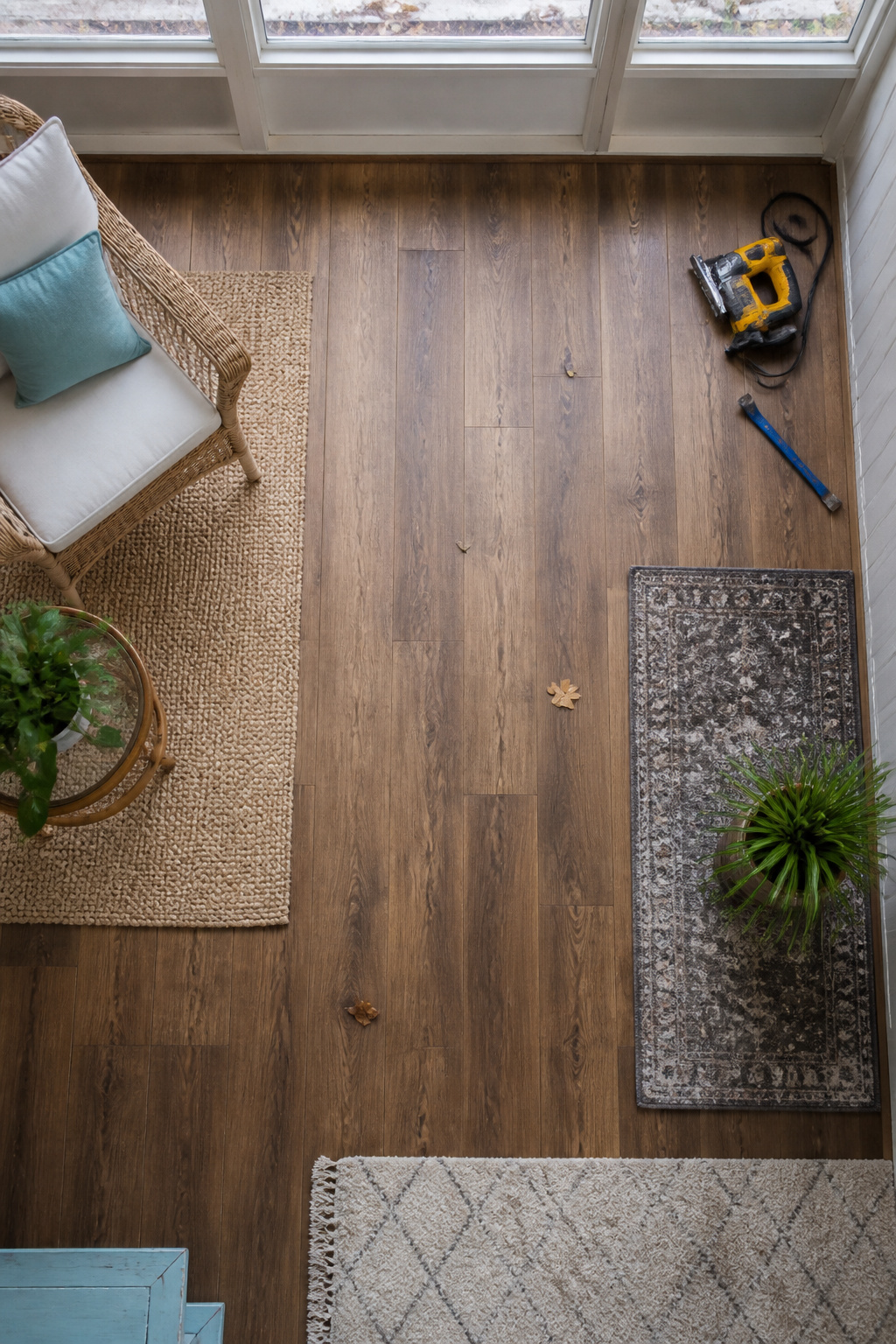
Laminate came in at just under two dollars a square foot, which made it the obvious first look. The samples clicked together fine on my kitchen table, but the actual porch had a concrete slab that dipped toward the drain. The 1/4 inch gap the instructions warned about turned out to be closer to 3/8 in the corner, and the locking edge on three planks cracked before I figured out I needed the rubber mallet, not the palm of my hand. I borrowed a jigsaw and a pull bar from a neighbor who had finished his basement the year before; the pull bar was what I actually used for the last two rows where the wall meets the floor.
Vinyl plank was the backup plan, running closer to three dollars but with a backing that forgave the slab better. The brand I found at a local flooring outlet had an attached cork layer that handled the slight unevenness without self-leveling compound, which saved a weekend and another fifty cents a foot in materials. It cut with a utility knife instead of a saw, so the dust stayed outside where it belonged.
Stone tile never got past the sample stage. Thinset and freeze-thaw cycles on a concrete base I did not fully trust felt like a project that would stretch past the long weekend I had blocked out. Hardwood was ruled out on price alone; the engineered options started around six dollars and still wanted perfect moisture control that my screen-to-window conversion could not promise yet.
10. Seasonal Decor That Does Not Overwhelm
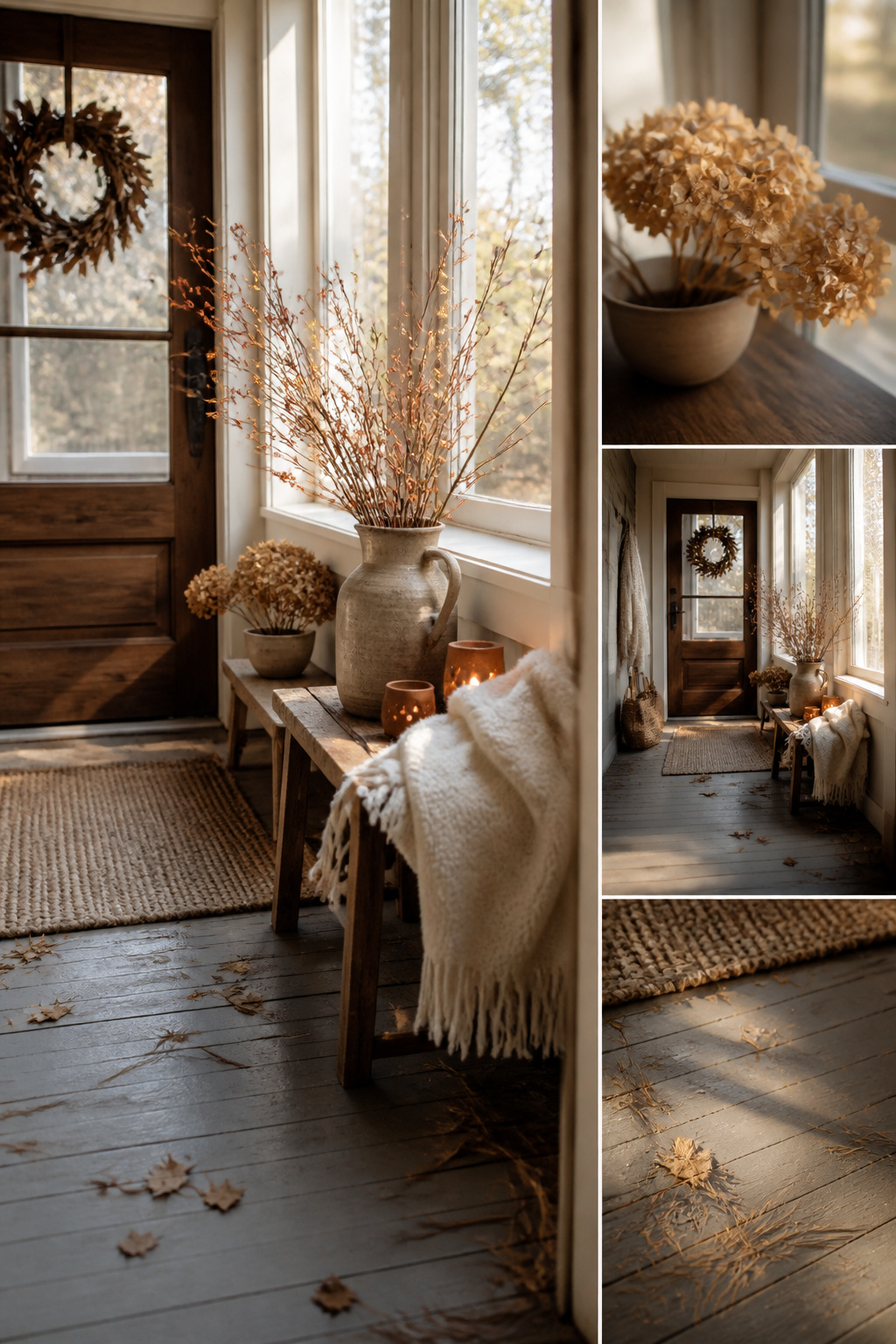
A small basket by the door holds the only seasonal pieces that stay in rotation: a cream wool throw, two terracotta votives, and a pressed-leaf frame I swap out four times a year. Everything else comes from the yard. Branches in a stoneware jug last three weeks and cost nothing. Dried hydrangea heads from the bush outside my kitchen window go straight into the same jug come August. The one store-bought exception is a faux berry garland I hang each October. It photographs well for about ten days, then sheds red dots behind the sofa until I find them in March. I stopped fighting it; now I shake it outside before it goes up and accept that a few escapees are part of the deal. Freshness does not require a storage unit. It requires one shelf, one walk around the block with pruning shears, and the discipline to throw out anything that needs a bin.
11. A Fireplace I Did Not Build
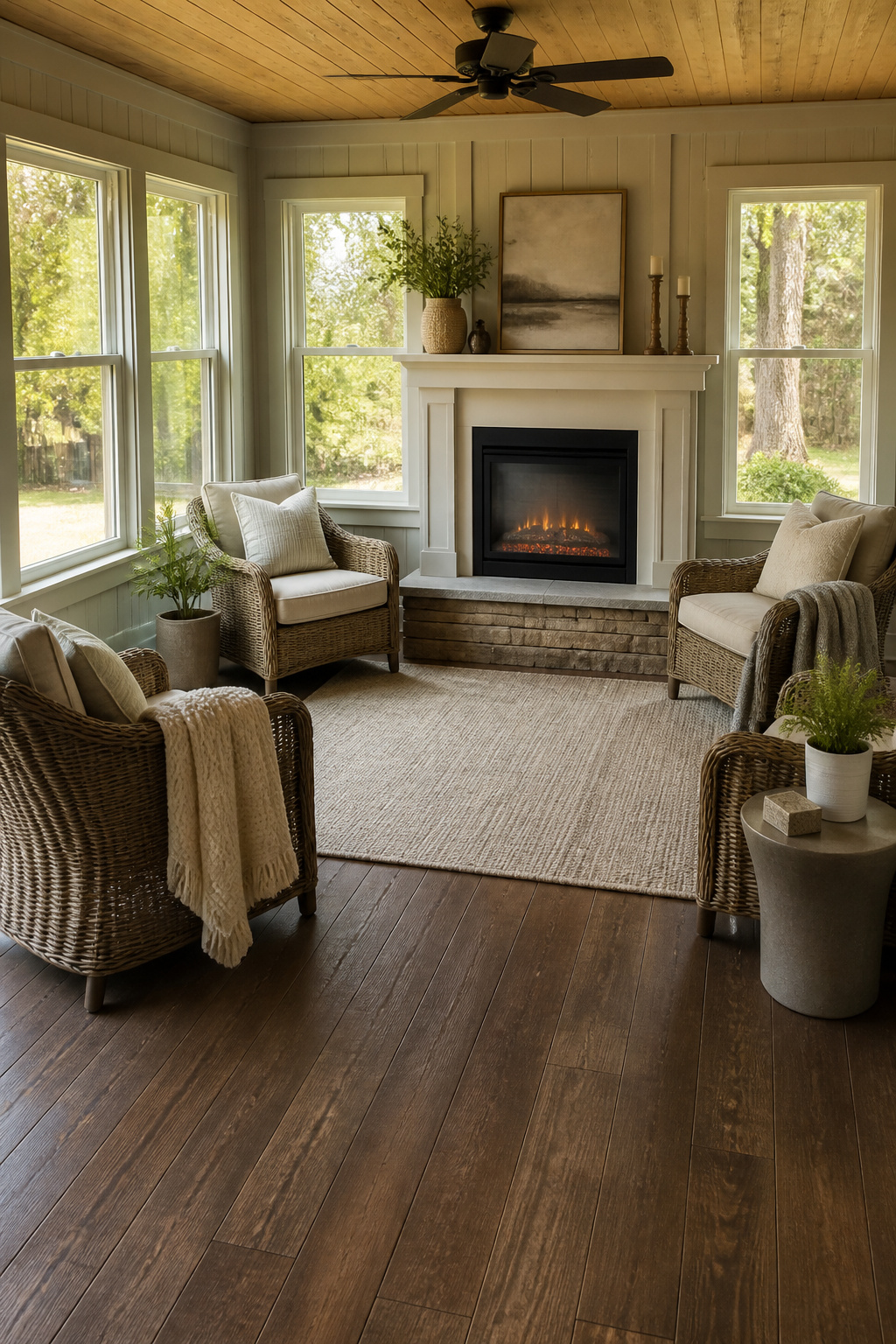
A working fireplace in an enclosed porch used to mean a mason, a permit, and a chimney that ate your whole budget. That has changed entirely.
Electric inserts now slide into a standard opening and plug into a normal outlet. The heat is real, the flame is LED, and the only installation is bracing the surround so it does not tip. Gel fuel burners run on cans of isopropyl alcohol, need zero venting, and put out enough BTUs to take the chill off a ten-by-twelve room. The cheap unit I lifted myself was a freestanding thing on wheels, a metal box with a glass front that runs on a propane tank hidden in its cabinet. It moved with me from the apartment porch to this house. No construction, no inspection, no hole in the roof.
The honest limit is output. None of these will heat a drafty porch in a Minnesota January like a gas line and a real firebox would. For a shoulder-season room or a mild-winter climate, though, they trade raw power for the possibility of having it at all. The ambiance is what you are actually buying; the warmth is a bonus that keeps you out there into November.
12. Views I Framed on Purpose
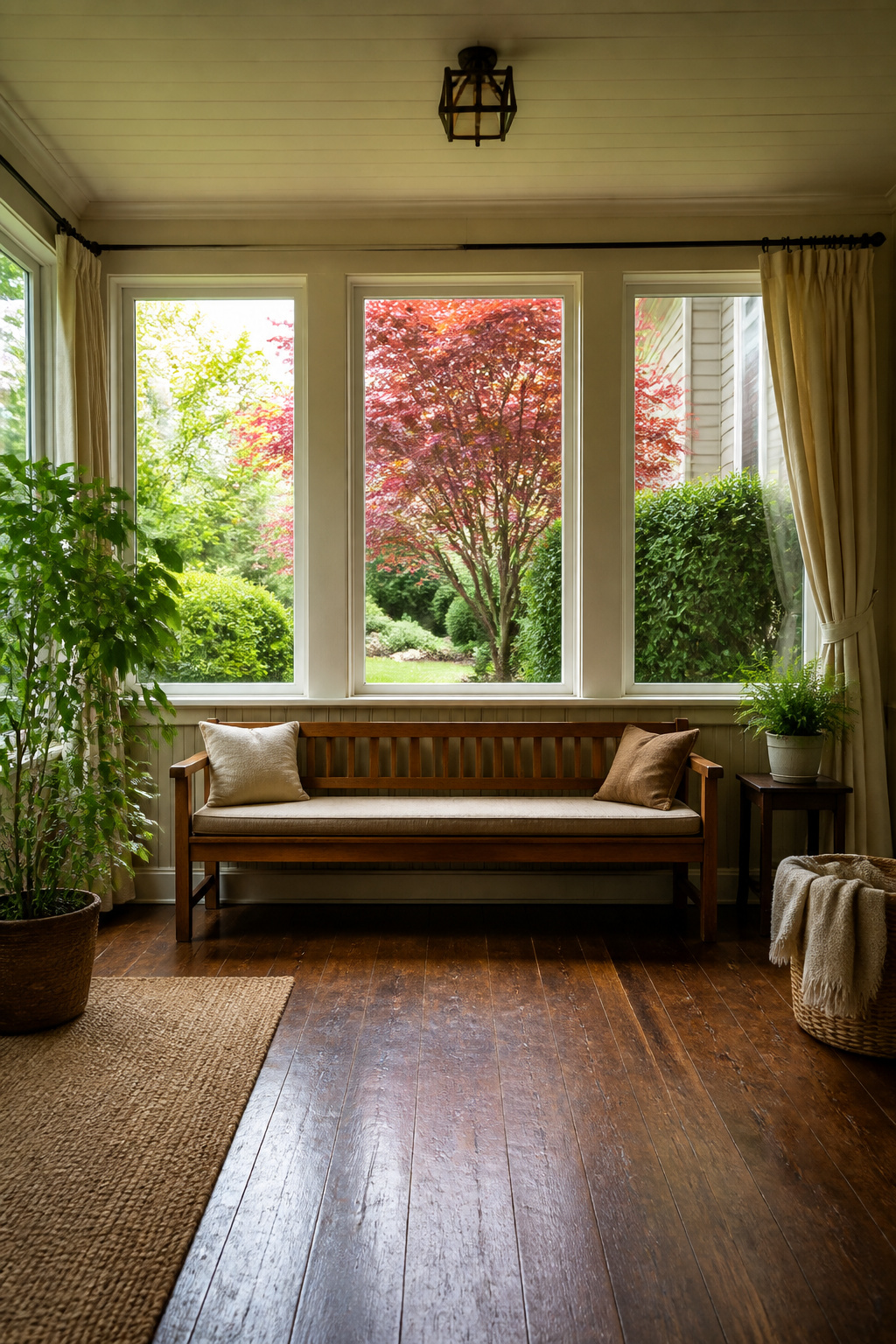
The east-facing wall of my porch had three windows, and the first thing I did was pull down the blinds I had inherited from the previous owner. They were honeycomb, decent quality, but they cut the room in half visually and made the space feel like a corridor. The blinds stayed up; the only window treatment now is a thin linen curtain on the south window that stays tied back except when the late afternoon sun turns that corner into a greenhouse.
I moved the seating to face outward, not inward. The old arrangement had two chairs angled toward each other like a conversation pit, which meant both people stared at the wall. Now a low bench sits under the center window with its back to the interior door. When you sit down, the yard fills your peripheral vision. The eye lands on a red maple about forty feet out that I had nothing to do with planting and take full credit for framing.
The bush I should have trimmed sooner was a forsythia that had grown into a lopsided screen blocking the left third of the view. I let it go for two summers because it flowered yellow in April and I told myself that counted as seasonal interest. It did not. By the third spring I cut it back hard, past the point that felt safe, and it recovered bushier and lower by July. The window now shows grass, then maple, then sky in three clean bands.
13. Color I Was Afraid to Use
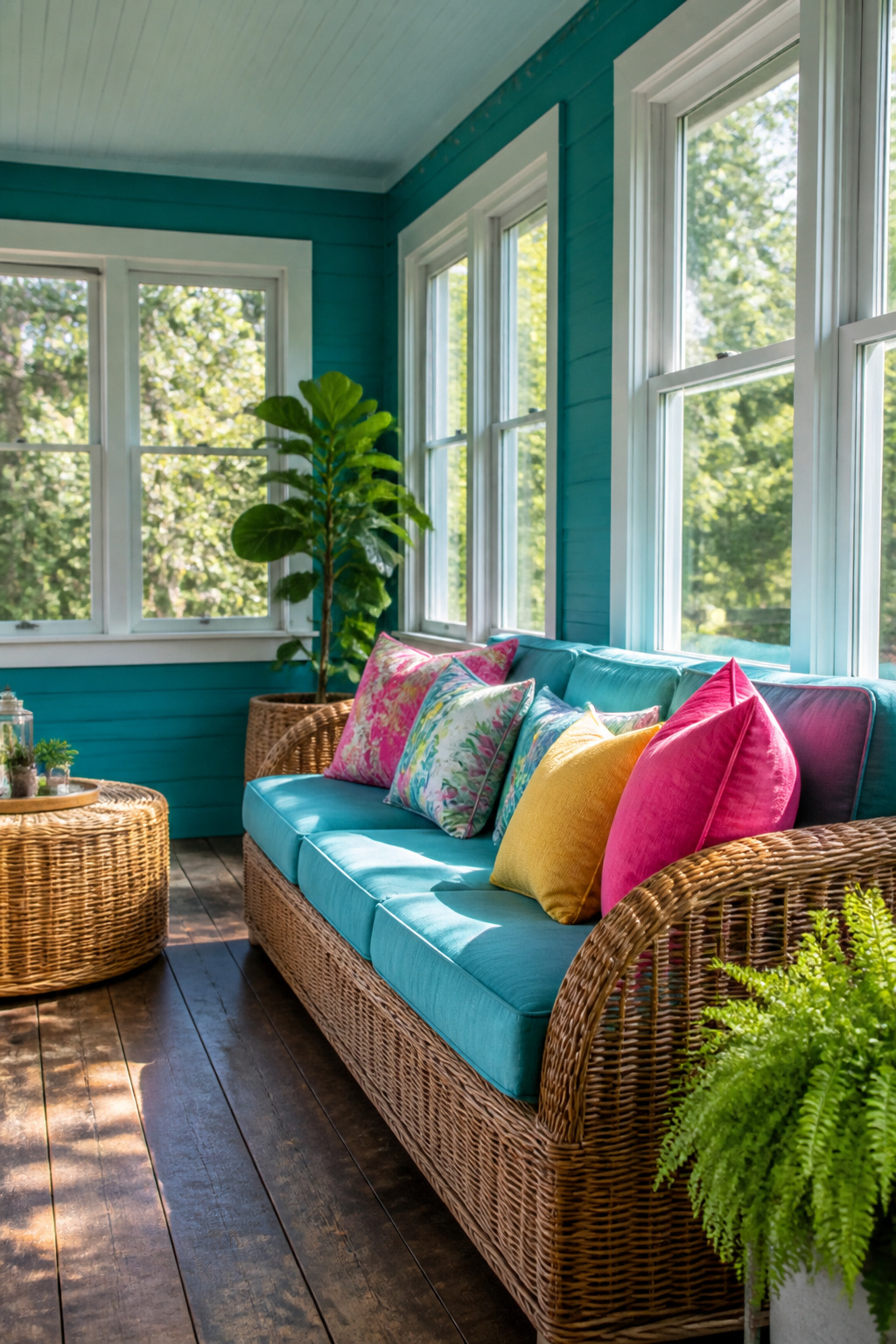
Beige was the safe choice I started with on my enclosed porch walls, and it died out there. The light shifts every hour, and that warm greige I loved at noon turned to dishwater by four. Teal was the color that finally woke the space up, though not the first teal I tried. The greener one went muddy; the bluer one fought with the sky visible through the screens. The third can, a teal with enough gray in its base, held steady from morning glare to evening shadow.
A designer in one of the projects I studied used purple for exactly this reason: the enclosed porch gets so much natural light that color behaves differently than it does in your living room. What reads as loud indoors settles to something lively but livable behind glass. I learned to test swatches on every wall, not just one, because the light direction changes the saturation that hits your eye. The south-facing corner needed a shade darker than the rest to look even.
Performance fabrics in bright colors and patterns are what make this practical. The camo-and-carnation mix from that Texas bungalow would not be my taste, but the principle holds: the porch can handle more color than you think because the outdoors around it absorbs the shock. Paint every inch one tone if you want moody, or keep the walls quiet and let a single big piece, a sofa or a ceiling, carry the weight. The light out here is doing half the work already; the color just has to not fight it.
14. One Room, Three Jobs
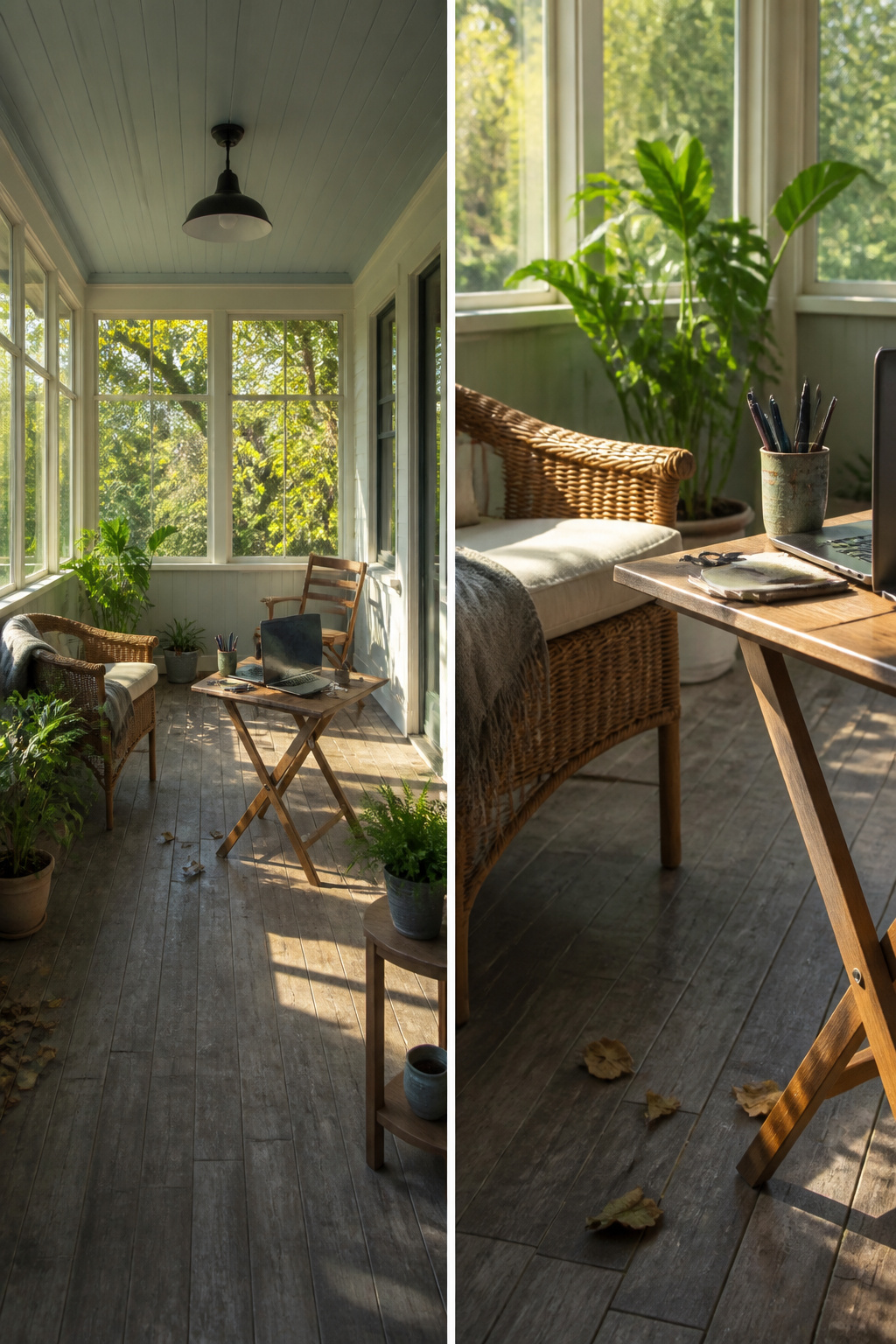
My enclosed porch does three jobs before noon. Coffee happens in the wicker chair angled toward the east windows, laptop work at the small teak table I drag into the center for afternoon light, and drinks back by the folding chair that lives in the corner, opened only when someone else joins. The folding chair is the whole trick: it signals evening without taking up floor space the other sixteen hours.
Zones need no walls. A small rug under the table keeps the work spot from sliding into breakfast, and the chair’s placement against the far wall makes the shift feel intentional. I tried a rolling cart for the transition and it just became clutter. The folding chair stays flat until six, then opens like a flag.
The teak sofa that converts to twin beds would be overkill here, but the principle is the same. Flexibility wins when the room is under 120 square feet.
The screened-in porch is the unsung hero of indoor-outdoor living. It offers all the same impeccable views and connection to nature as a patio, porch, or veranda—yet it has the comfort of a family room and protection from pests and the weather.
— Veranda
What that means in practice: you stop treating the porch as a second-class room and start asking it to work as hard as the kitchen. Three jobs, one space, no renovation required.
Why I Enclosed It at All
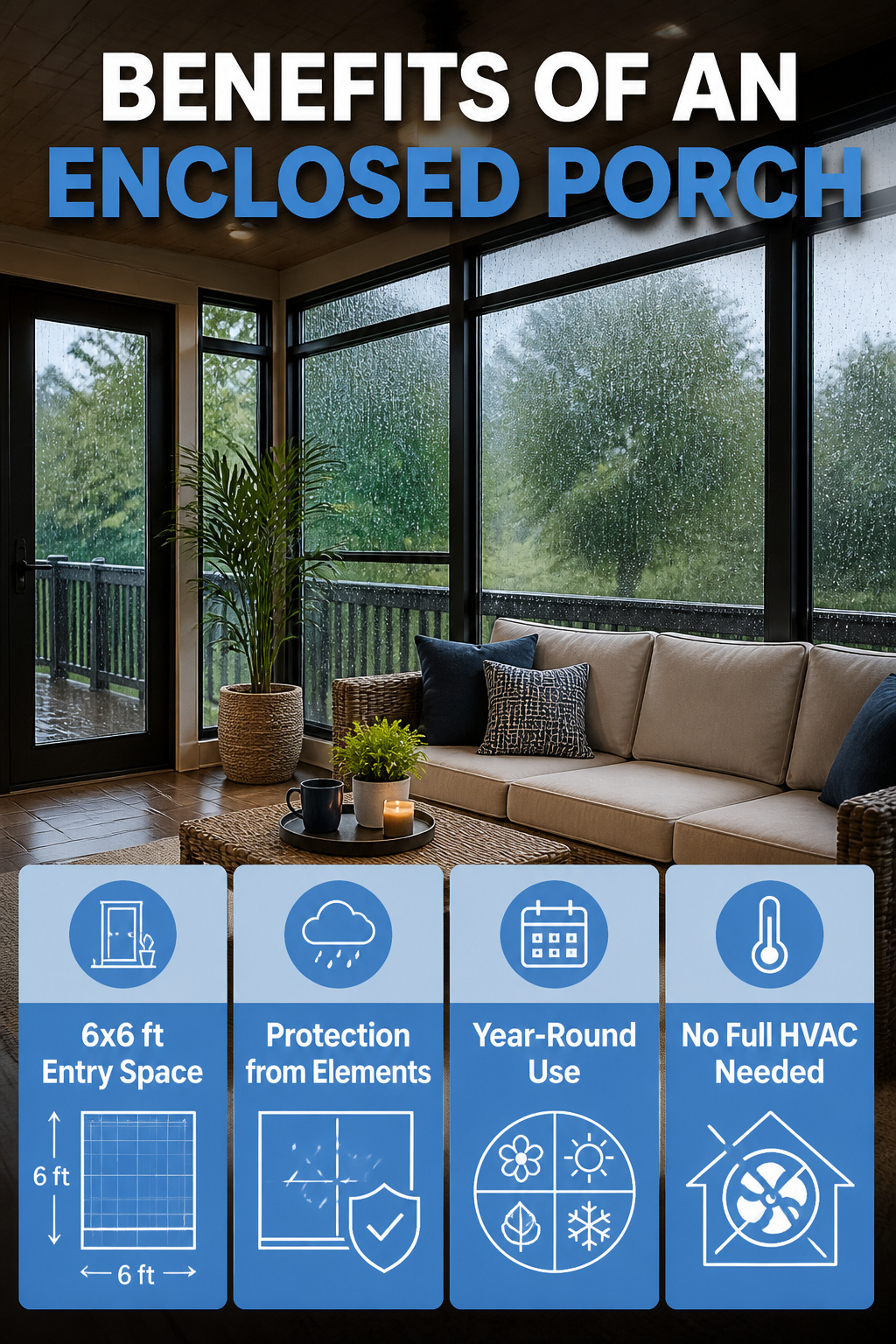
An enclosed porch buys you square footage you do not have to heat like the rest of the house. That was the math that mattered in my place: a narrow 6-by-6 ft entry with 25-foot ceilings and no room to breathe past the stairs. The raw porch off the back added nothing usable until it was sealed.
Protection from the elements is the benefit everyone names, but the first real storm is what converts the idea into a room you trust. Mine came three weeks after the last panel went up, a hard spring rain that would have sent the old porch furniture into storage. Instead I sat out there with coffee and watched the water sheet down the new glass while the screens I had kept in the upper panels held their shape against the wind. No bugs, no wet cushions, no sprinting to roll up outdoor rugs.
Year-round use is the selling point, yet the practical gain is simpler: one more conditioned space that does not demand full HVAC. The porch extends the house without extending the utility bill on the same curve. Curb appeal and resale value follow, but those are futures. The present value is a Tuesday morning with rain on the glass and your feet still dry.
What Enclosed Actually Means
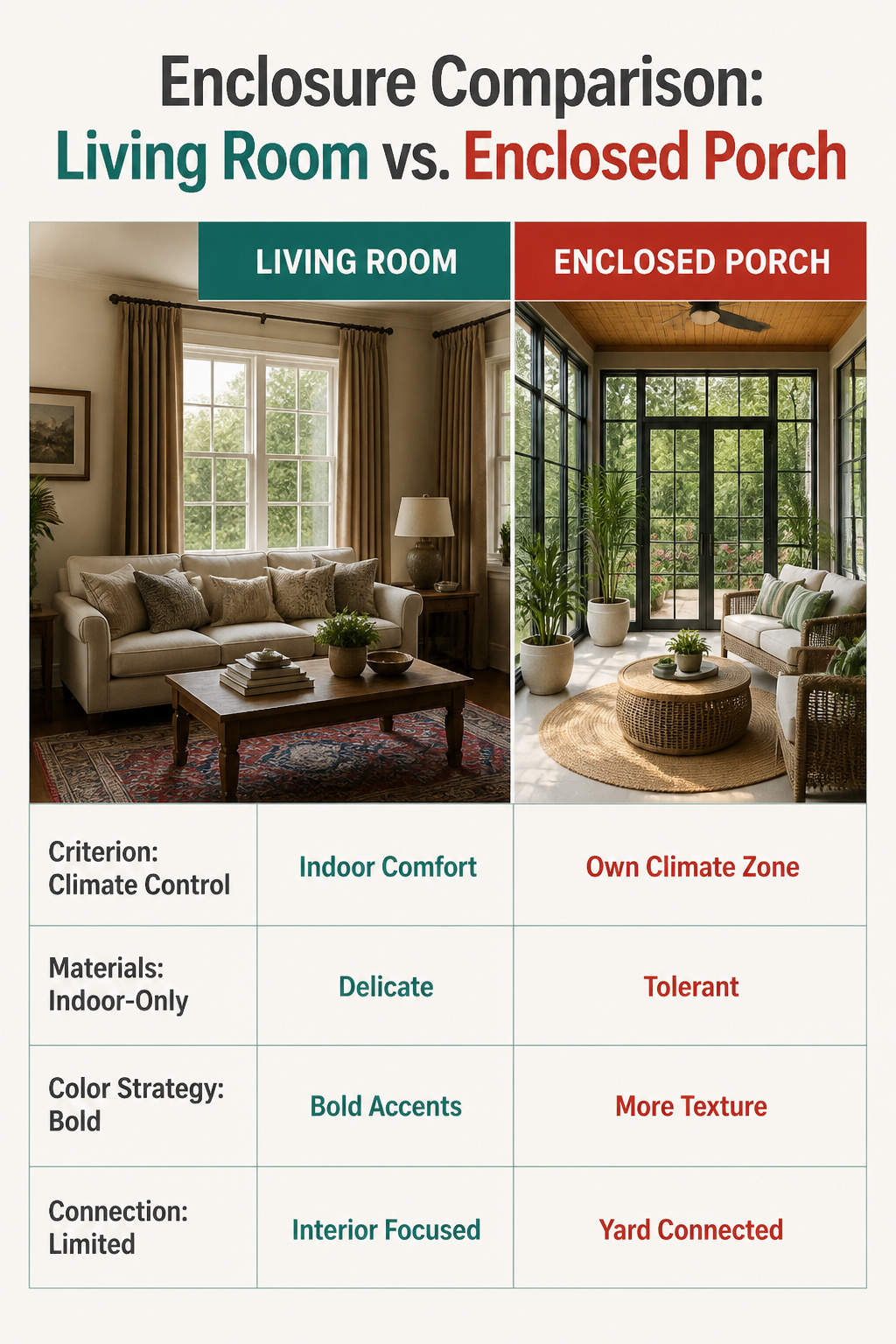
The first enclosed porch I designed felt like a living room that happened to have windows. Thick drapery, indoor-only upholstery, a wool rug I moved out from the den. Two humid summers later the rug smelled like a basement and the drapery had mildew at the hem. The fix was treating the room as its own climate zone, not as an extension of the house interior.
Sources call this balance indoor-outdoor living, but the practical version means materials that tolerate both sides. Outdoor rugs with indoor softness, fabrics rated for sun and moisture, plants in containers rather than built-in planters that trap water against the frame. The steel-framed glass doors I now prefer act as a visual conduit; they read as architecture, not as a barrier you are trying to hide.
Color works the same way. Maggie Griffin’s approach of adding more texture than color so the yard’s greens take center stage reads as restraint, but it is actually strategy: the eye travels past the room to the view, and the room becomes a frame. The purple couch Virginia Toledo used works only because it echoes something alive outside, a floral print or the actual garden. Without that link, bold color in an enclosed porch looks like a sofa got lost on its way to the parlor.
The mistake is assuming enclosure means bringing the indoors out. What it really means is stopping the weather without stopping the connection.
Year-Round Is a Promise
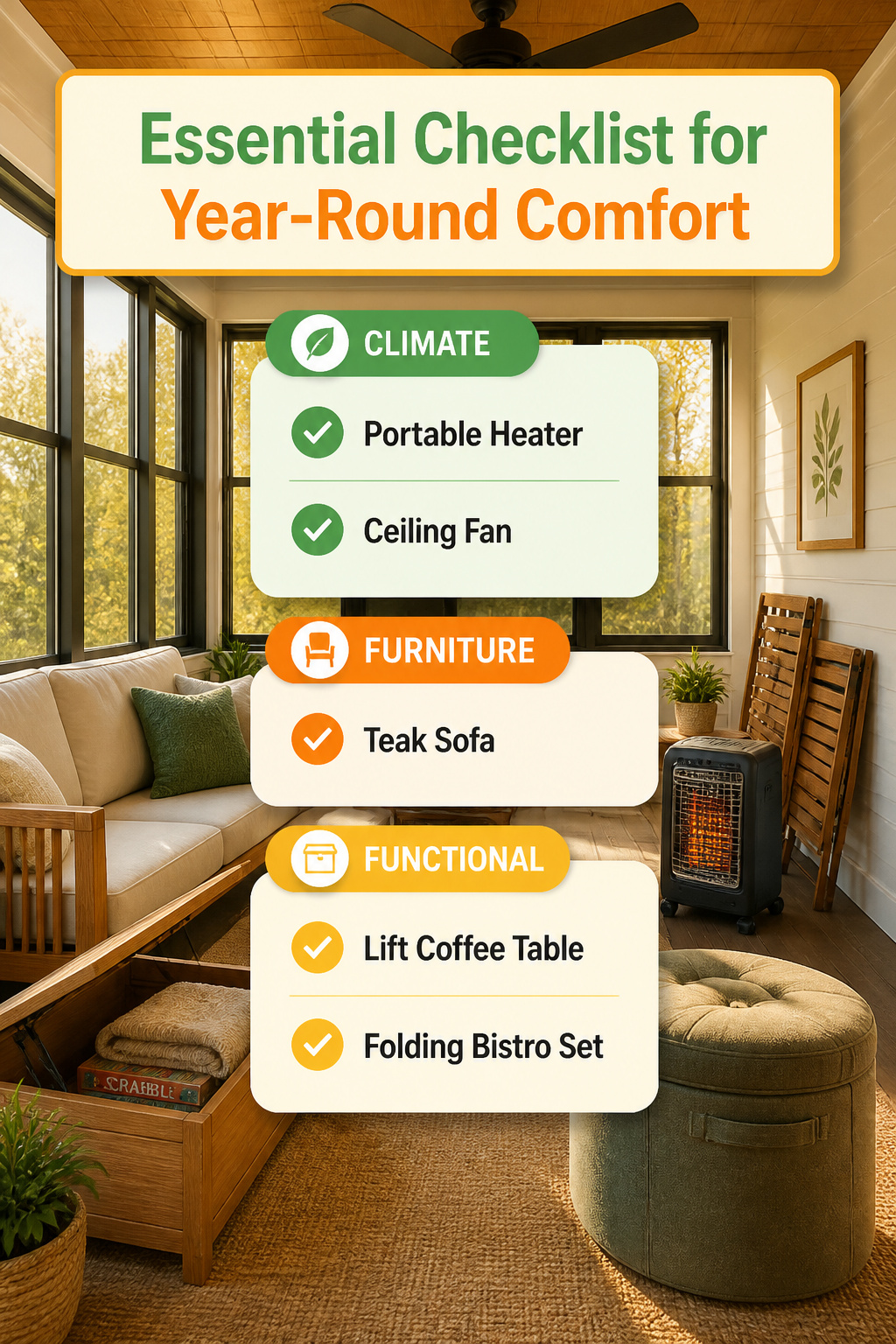
Year-round use starts with admitting what "enclosed" actually blocks. My porch has walls and windows, but the October air still finds the gaps. A small portable heater lives out there from mid-October through November, then moves to the closet when April mornings turn mild enough for coffee without it. The ceiling fan runs both seasons; in October it pushes warm air down, in April it buys a breeze before the windows go wide.
What stays put is what survives the swing. A teak sofa with cushions I can store in the house. A coffee table with a lid that lifts for blankets in one direction, board games in the other. The bistro set folds flat against the wall when I need floor space for a project. Aluminum frames on the windows were worth the slight cost jump; they have not warped in three years of temperature swings, and the light coming through is the reason I wanted this room to begin with.
The furniture that converts, twin-bed style, still tempts me for overnight guests. For now the ottoman that stores and seats handles the flexibility I actually use weekly.
Frequently Asked Questions
What are some ideas for decorating an enclosed porch?
Start with seating built for humidity shifts, like wicker, rattan, or aluminum frames with all-weather cushions. Add layered lighting with dimmable overhead fixtures, task lamps, and wet-rated accent strings. Bring in low-maintenance plants such as ferns and spider plants, and finish with personal pieces like thrifted blankets or rebuilt furniture that make the space feel collected rather than styled.
How can I make my enclosed porch usable year-round?
A portable heat pump with a window vent kit, around $350 and $40–$60 monthly to run, handles both heating and cooling without touching your main HVAC. Pair it with retractable motorized screens for airflow in warmer months, or fixed screens with removable lower panels if budget is tighter. The goal is treating the porch as its own climate zone rather than an extension of your interior.
What types of plants are best for an enclosed porch?
Ferns and spider plants tolerate the dim, filtered light and humidity swings that come through storm windows and open doors. A Boston fern can survive neglect through multiple winters, and spider plants keep propagating regardless of rotation. Water only when the pot feels light, roughly half as often as indoor plants, since porch air holds moisture differently.