Kitchen cabinets without handles are cabinets that open through built-in grips or push-to-open mechanisms instead of protruding knobs or pulls.
The look stays smooth and modern, but the opening system affects how much daily maintenance the kitchen needs and how much the cabinets cost.
A J-pull groove collects grease faster than a flat front, and push-to-open hardware costs more than standard hinges.
What Handleless Kitchen Cabinets Are
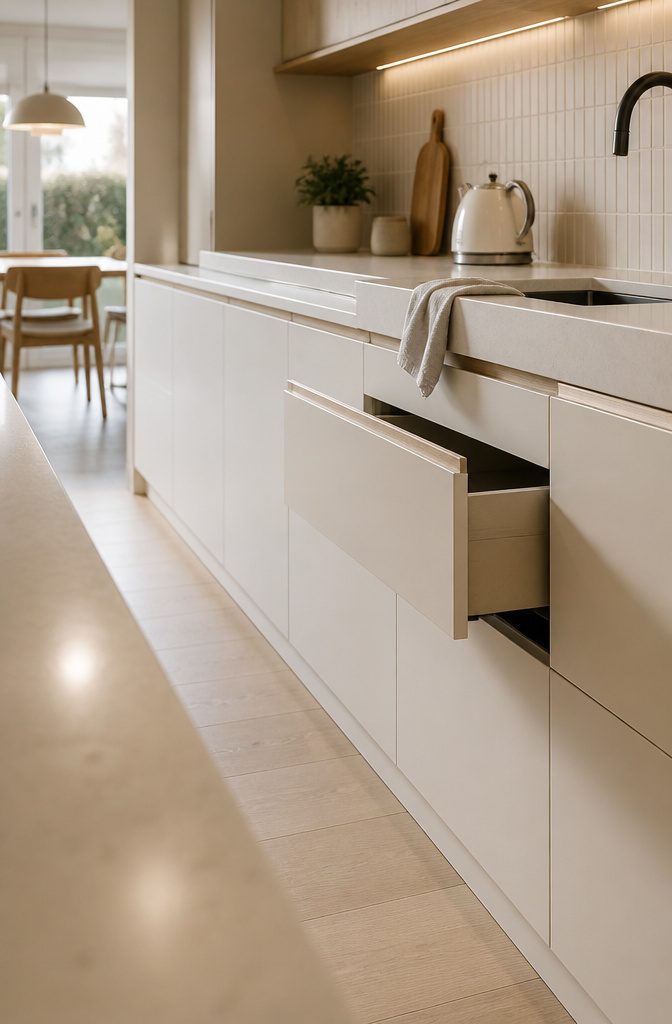
Handleless kitchen cabinets are cabinets without traditional knobs or protruding handles.
Doors and drawers open through a built-in grip—a J-pull, a Gola channel, a recessed finger pull—or through a push-to-open mechanism. The result is a smooth, uninterrupted front.
The look suits modern and minimalist kitchens, but the idea is simple and the execution matters.
The opening system affects how the kitchen feels to use, how it gets cleaned, how the cabinets are built, and how much the whole kitchen costs. A J-pull has a groove built into the cabinet front itself.
A Gola rail uses a recessed rail or finger channel behind the front, creating a cleaner slab-front look. Push-to-open cabinets release with a light press and keep the front completely smooth.
Each version keeps the front uninterrupted, but the grip, the maintenance, and the planning needs change with the system you choose.
1. How Each Opening Method Works
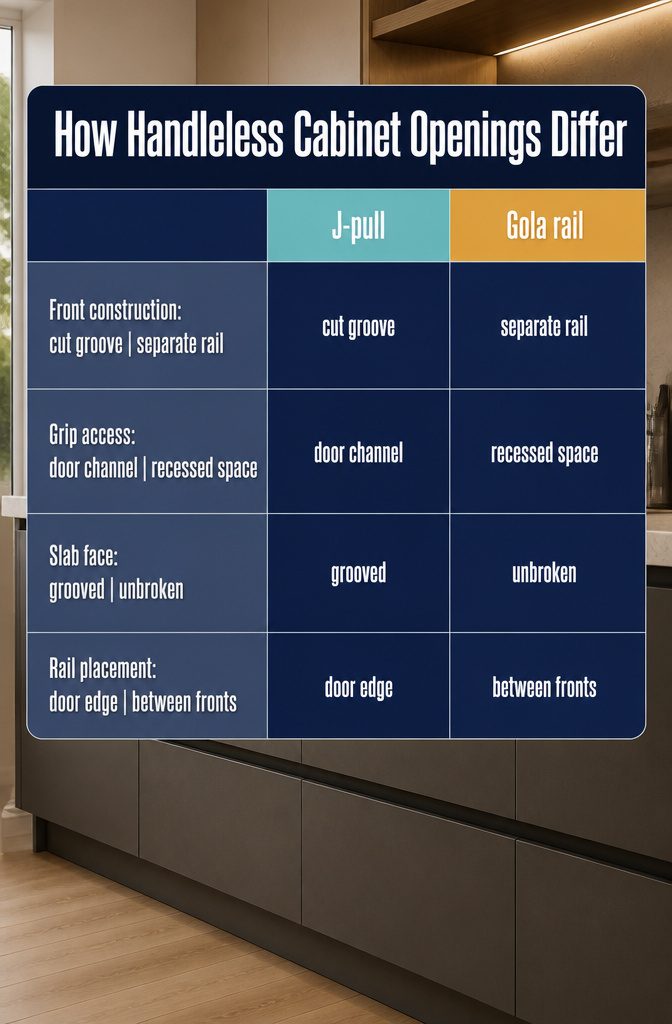
The simplest handleless option is a groove cut along the top edge of the door or drawer, often called a J-pull.
Your fingers hook into the channel and pull. The groove is part of the front itself, so nothing is added afterward and the profile stays clean.
A Gola rail takes a different approach. Instead of cutting into the door, a horizontal aluminum channel runs along the edge where two fronts meet or where the countertop meets the cabinets.
Your fingers slide into the recessed space behind the door front and pull from there. This keeps the slab face completely unbroken, which is the look most European handleless kitchens are built around.
Finger pulls and lip pulls are slim pieces of metal set into the edge of the door. They recess into the top or side, giving you a small ledge to grip without protruding into the room.
They still count as hardware, but the face stays smooth and the pull reads as part of the cabinet line rather than an attachment.
Push-to-open mechanisms work without any grip at all.
Press the front near the outer edge and a spring-loaded latch releases the door. The system needs good-quality hardware and careful adjustment, especially on heavier drawers or trash pull-outs, but it gives you the cleanest possible slab front.
2. What the Front Looks Like

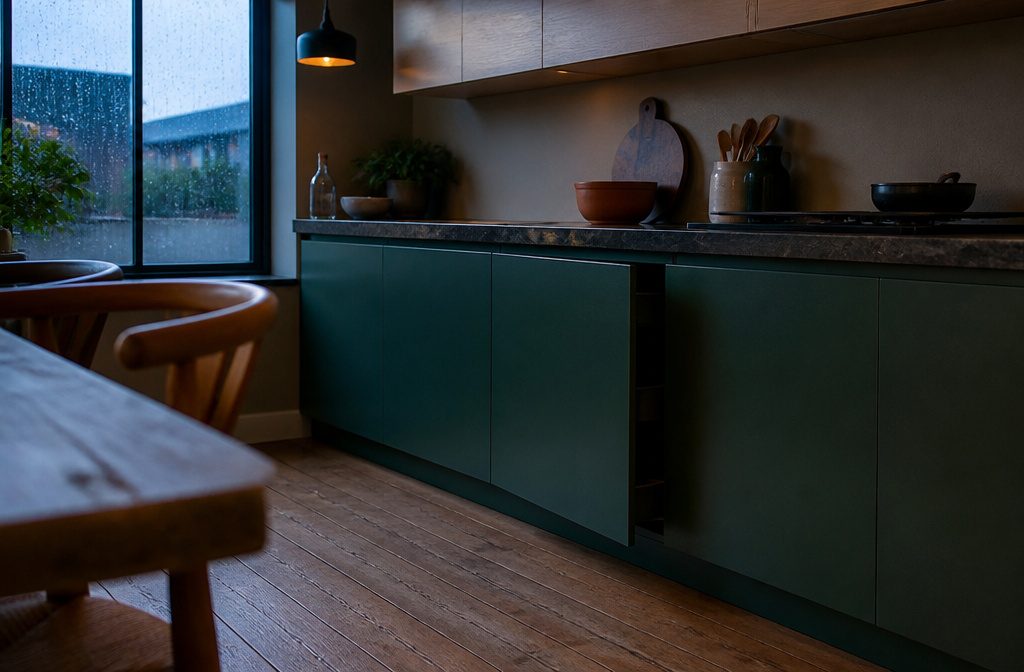
The difference between systems shows the moment you stand in front of the cabinet. A push-to-open front stays completely flat—no groove, no rail, no visible interruption anywhere on the panel.
That smooth surface is why the look works in compact kitchens and open-plan spaces: nothing breaks the line, so the eye reads the wall as one plane instead of stopping at hardware.
A recessed rail or J-pull gives you something to hook your fingers into, and that groove or profile becomes a design line rather than disappearing.
I prefer the rail when the kitchen opens to the living room, because the horizontal line reads as deliberate rather than stark, especially when the rail color contrasts with the door.
A light countertop keeps a dark rail from weighing the space down.
The flat front wins if the goal is pure minimalism, but it asks for precise construction and quality latches to make the press-and-release motion feel solid rather than cheap.
3. Grip Comfort and Daily Use

Testing the opening system before you install it saves more frustration than any other single step.
Long fingernails catch on recessed grips, limited hand strength struggles with push-to-open mechanisms on heavy drawers, and what feels smooth in a showroom can turn awkward when you’re pulling out a drawer full of dishes twice a day.
Open and close a sample door a dozen times with a full load if the showroom allows it. If one person in the household finds a grip style frustrating, a different handleless option will likely work better.
J-pulls and Gola channels are easy for anyone to use.
Push-to-open and true handleless systems need good hardware and some getting used to. Handles themselves are instantly understandable, which is worth considering if multiple people use the kitchen or if reach and height vary.
Heavy drawers, tall units and high wall cabinets deserve extra attention: check the grip position for each user’s height, and test how heavy items feel to open.
A proper design consultation catches problems that a render does not, because a mock-up shows what your hands will actually do.
4. What Each System Needs to Stay Clean

Grooves and channels pick up dust and grease faster than flat fronts. J-pulls and Gola rails both leave a horizontal recess where your fingers go, and anything that lands there stays until you run a cloth through it.
A weekly wipe with a microfiber cloth keeps them looking sharp, but if you cook with oil often, those recesses can start to feel sticky within a few days.
Push-to-open fronts skip the channel problem but replace it with fingerprints.
Every press leaves a mark, and dark matte finishes show them worst. Gloss and light lacquer hide prints better, though they still need attention if you want them to stay invisible.
Traditional handles trap grease around the screws and under the backplate, and cleaning them means working a cloth into every angle.
I would take a smooth groove over fussy hardware any day, but the groove still asks for regular passes to stay clean rather than forgiven.
5. Planning the Layout Before Production

Some handleless systems look like a simple swap, but others need decisions made before the cabinet boxes are built.
Gola rail systems create that recessed finger channel behind the front, which means the rail takes up space inside the cabinet layout.
Drawer heights, appliance panel dimensions, and rail placement all get locked in during production rather than adjusted on site.
Integrated appliances sit behind matching fronts in a handleless kitchen, so the fridge, dishwasher, and oven dimensions affect the cabinet sizing around them.
Pick the appliance models early. Each one needs compatible opening hardware and precise clearances, and flat fronts leave little room to fix a collision between an open door and a pull-out drawer after installation.
Heavy drawers, trash pull-outs, and corner cabinets add another planning layer. Push-to-open mechanisms need enough clearance to work smoothly, and soft-close dampers need space inside the box.
J-pull profiles and recessed rails make more sense for new cabinetry than for retrofitting existing boxes, since the cabinet front profile has to match the opening method from the start.
6. Hardware and What It Costs

Handleless systems generally cost more than a comparable kitchen with handles.
Profiles, precision machining, and higher-grade push-to-open or soft-close hardware all add to the price. The gap varies widely by system, so comparing specific options beats assuming a fixed premium.
Push-to-open cabinets depend on hardware quality and proper adjustment.
When the mechanism is set correctly, a light press releases the door cleanly. When it is not, you get sticky operation or doors that drift open on their own.
Soft-close is a separate function; if your cabinets have it, check that it engages smoothly and does not slam or stop too early. These are straightforward checks during installation, but they matter for years of use afterward.
Push-to-open works best on upper cabinets, tall cabinets, and lighter-use areas. For heavily used drawers, trash pull-outs, or appliance panels, the fronts are touched directly and show fingerprints faster, so the system needs more careful planning.
7. Whether Existing Cabinets Can Be Converted

Most existing cabinets can take finger pulls, lip pulls, or push-to-open hardware if the fronts are flat, the hinges work with the system, and the door spacing allows it. Those retrofits give you a handleless look without replacing the boxes.
J-pull fronts and Gola rail systems are harder to add later because they depend on specific front profiles or cabinet box planning that standard cabinets were not built around.
I have seen retrofit attempts that required so much reworking of the door edges or box interiors that ordering new fronts ended up cheaper and cleaner.
Both systems make more sense when planned before cabinet production, which is why most contractors recommend them for new builds or full replacements rather than updates to what is already there.
If a true handleless kitchen is the goal, planning the opening method before the cabinets are made saves time and usually money.
Standard Versus Custom Cabinets
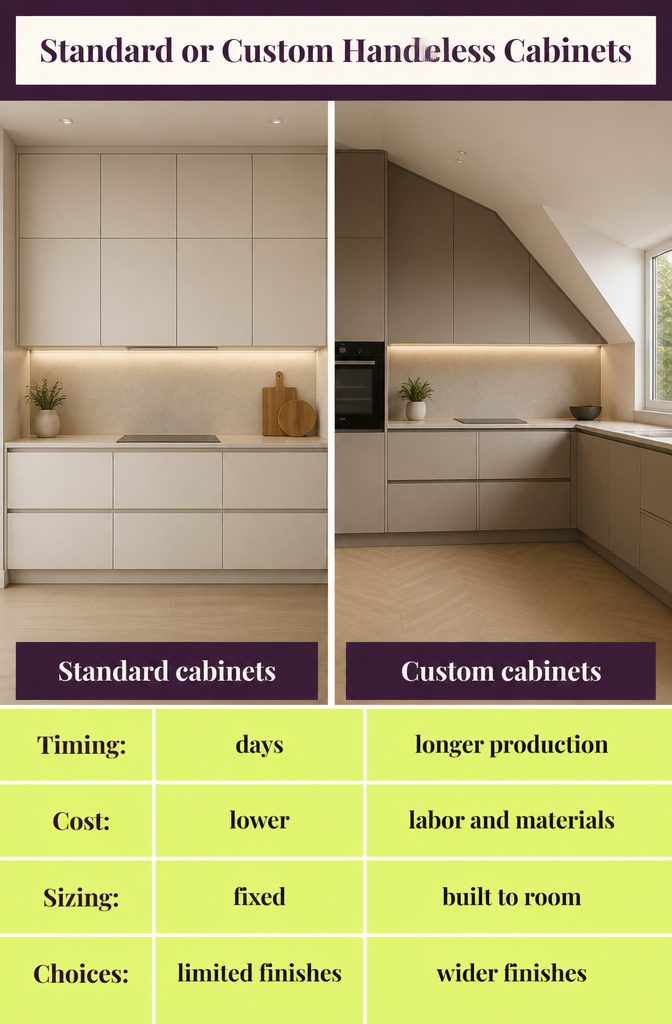
Standard cabinets arrive ready to install in fixed dimensions, usually on a timeline measured in days rather than weeks.
The cost sits lower because the manufacturing scales across hundreds of orders, and the design decisions have already been made. Fixed sizing and limited finish options leave less room to tailor storage or fit irregular walls.
For a handleless design, standard cabinets work well in kitchens with straightforward layouts where the push-to-open hardware and recess profiles are already part of the catalog.
Custom cabinets start with the room as it is: odd angles, specific ceiling heights, the exact depth you need for a peninsula that doubles as a breakfast counter.
Production time stretches longer because each piece is built to order, and the price reflects the labor and material selection. Inside, you can specify pull-out trays, hidden organizers, adjustable shelves that match how you actually use the space.
The handleless finish options range wider too, from high-gloss to matte, and the fit is tight even where walls are not perfectly square. That precision matters most in high-end projects or layouts that would leave visible gaps with off-the-shelf sizing.
Which Finishes Show Marks and Which Hide Them

High-gloss and dark finishes show every fingerprint along the cabinet edge where you push to open, so matte or textured surfaces are far more practical for handleless doors you touch several times a day.
Lacquered fronts in navy or black look sharp on installation day but need wiping down constantly. Matte lacquer, textured laminate, or a wood grain finish hides the marks without sacrificing the clean lines.
MDF and plywood both take either finish well, and laminate or melamine surfaces resist stains and scratches while mimicking wood grain at lower cost.
I’d put high-gloss where brightness matters and you don’t touch often, and matte or textured fronts on the base cabinets and anything at arm level.
The pairing makes one color look like two without adding visual noise, and you’ll spend less time wiping down smudges before guests arrive.
Fewer Bumps and More Room in Tight Layouts

Fewer Bumps and More Room in Tight Layouts
Removing handles stops the everyday snag. Without protruding hardware, nothing catches your sleeve when you reach past a cabinet or bumps your hip when two people pass in a narrow aisle.
Families with young children get an added benefit: no sharp corners or edges sticking out at waist height.
The gain shows most in compact kitchens.
A handle projects a few centimeters, and in a tight galley or U-shaped layout that small distance affects how comfortably two people can move at once. Handleless fronts keep the aisle clear and make the space feel less crowded.
Smooth cabinet runs also read as one calm surface rather than a line of repeating hardware, so a small kitchen feels larger and an open-plan layout flows into the living area without visual competition.
I’d call it the better pick when square footage is tight or when the kitchen sits fully open to another room.
Frequently Asked Questions
What are handleless kitchen cabinets?
Handleless kitchen cabinets are cabinets without traditional knobs or protruding handles. They open through a built-in grip like a J-pull groove, a Gola channel, a recessed finger pull, or through a push-to-open mechanism that releases with a light press.
The result is a smooth, uninterrupted cabinet front that suits modern and minimalist kitchens.
How do handleless kitchen cabinets work?
They work through one of several systems: a groove cut into the door edge that you hook your fingers into and pull, a recessed rail behind the door front where your fingers slide in to grip, a small recessed pull set into the edge, or a spring-loaded mechanism that releases the door when you press the front.
Each method keeps the cabinet face smooth while giving you a way to open it.
Are handleless cabinets practical?
They can be practical when the opening system matches how the kitchen gets used and who uses it.
Testing the grip before installation matters, since what works in a showroom can feel awkward when you’re opening a heavy drawer full of dishes twice a day.
Push-to-open systems need quality hardware and careful adjustment, while J-pulls and Gola channels are easier for most people to use right away.
Can you make existing cabinets handleless?
Most existing cabinets can take finger pulls, lip pulls, or push-to-open hardware if the fronts are flat and the door spacing allows it.
J-pull fronts and Gola rail systems are harder to add later because they depend on specific front profiles or cabinet box planning that standard cabinets were not built around.
Both systems make more sense when planned before cabinet production rather than as retrofits.
What is the difference between J-pull and Gola rail cabinets?
A J-pull has a groove cut along the top edge of the door or drawer, so your fingers hook into the channel and pull.
A Gola rail uses a horizontal aluminum channel that runs along the edge where two fronts meet, and your fingers slide into the recessed space behind the door front.
The J-pull is part of the door itself, while the Gola rail keeps the slab face completely unbroken.
Are push-to-open cabinets practical?
They work well on upper cabinets, tall cabinets, and lighter-use areas where the clean slab front matters most.
For heavily used drawers, trash pull-outs, or appliance panels, the system needs high-quality hardware and careful adjustment since the fronts get touched directly and show fingerprints faster.
A light press near the outer edge releases the door cleanly when the mechanism is set correctly.
Do handleless cabinets get dirty faster?
Grooves and channels pick up dust and grease faster than flat fronts, so J-pulls and Gola rails need regular wiping to stay clean. Push-to-open fronts skip the channel problem but show fingerprints on every press, especially on dark matte finishes.
Traditional handles trap grease around the screws and under the backplate, so a smooth groove or flat front usually stays cleaner with less effort.